

Yes, AI chatbots can recommend your brand without a Wikipedia page. Answers can draw on information learned during training, sources retrieved through web search and context supplied in the conversation; Wikipedia is not a universal prerequisite. A recommendation still needs checking: the chatbot can name your brand while giving an inaccurate reason for choosing it.
- Can AI chatbots recommend a brand without a Wikipedia page? Yes: Wikipedia is not a prerequisite.
- Track mentions, citations and recommendations separately; each measures a different AI visibility outcome.
- Test unbranded buyer questions, not just prompts that already name your company.
- Koalr suits marketing teams tracking brand presence in AI answers; tracking alone does not secure recommendations.
Can AI chatbots recommend a brand without a Wikipedia page?
Yes. A Wikipedia article is one possible source of information, not an admission requirement for chatbot recommendations. The useful question is whether an answer accurately connects your brand to the buyer's stated need.
Start with a repeatable test rather than a Wikipedia project. Build a set of relevant buyer questions using the process in how to build a prompt library for AI visibility tracking, then inspect the complete answers and any linked sources.
- Ask an unbranded question. Describe the problem, audience and relevant constraints without naming your company.
- Save the answer. Record the platform, date, prompt, search setting and relevant conversation context.
- Classify your appearance. Separate a name-check from a source citation and an actual recommendation.
- Verify the explanation. Check whether the capabilities and limitations attributed to your brand are true.
- Repeat under comparable conditions. Keep the prompt and settings consistent before treating differences as a trend.
This establishes what you can observe. A chatbot recommending your brand without citing Wikipedia demonstrates that Wikipedia was unnecessary for that answer; it does not reveal every source involved in producing it.
Why this matters
Do not make Wikipedia eligibility a dependency for your 2026 visibility work. You can improve the accuracy, accessibility and usefulness of your public information without an encyclopaedia article.
Wikipedia's organisation notability guidance centres on significant coverage in reliable, independent secondary sources. Its conflict-of-interest guidance also matters when someone connected to a company edits material about that company. A promotional page is not a substitute for independent coverage.
For a SaaS marketing team, the more actionable problem is narrower: does an answer understand your category, identify a genuine use case and explain why you fit? A familiar brand name attached to the wrong capability is not a useful recommendation.
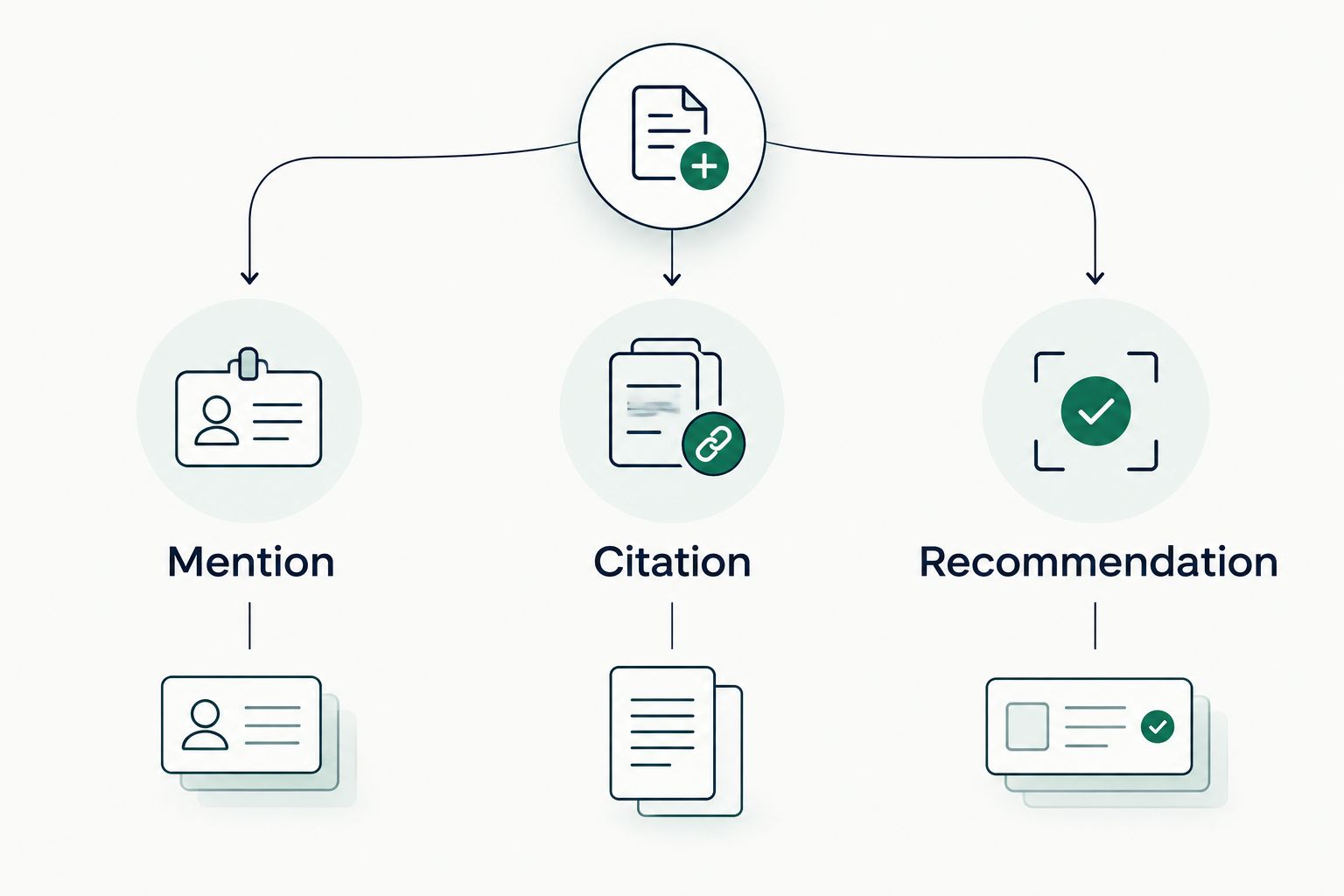
Separate 3 outcomes: mentions, citations and recommendations
Count 3 outcomes separately in your reporting. They answer different questions, and none should silently stand in for another.
| Outcome | What you observe | What it establishes | What it does not establish |
|---|---|---|---|
| Mention | The answer names your brand | Your brand appears in that response | The answer endorses your brand |
| Citation | The answer links to a source | A visible source accompanies the answer | Every nearby claim is supported by that source |
| Recommendation | The answer suggests choosing or considering your brand | Your brand is presented as relevant to a need | The reasoning is accurate or consistent across answers |
An answer can cite your documentation to explain a technical process without recommending your product. It can also recommend your product while linking to an independent review rather than your website.
Inspect the sentence, not just the brand count. Record the stated use case, any caveat and whether the supporting source actually substantiates the claim. That is how you distinguish useful visibility from an impressive-looking mention total.
Where can a chatbot find information without Wikipedia?
When web retrieval is available, a chatbot can use sources beyond Wikipedia. Without retrieval, an answer can reflect training information or context already supplied in the conversation. Do not infer the route from the confidence of the wording.
The source types below serve different purposes. Treat the “best for” labels as guidance for building useful evidence, not as a ranking of sources preferred by every chatbot.
| Source type | Best for | Strength | Limitation |
|---|---|---|---|
| Official product documentation | Verifiable functionality | Lets you describe supported behaviour precisely | Does not independently establish that you outperform alternatives |
| Official use-case pages | Explaining buyer fit | Connects a product to a specific problem | Broad claims without evidence remain self-promotion |
| Independent reporting | External context | Provides information outside your editorial control | Coverage can omit details or become outdated |
| Customer reviews | Reported user experience | Adds context from people describing use | Individual experiences are not universal product facts |
| Wikipedia | Encyclopaedic background | Summarises material under editorial policies | Requires suitable sourcing and is not controlled by your marketing team |
Build evidence for the claim you want an answer to make. Documentation is appropriate for a supported integration; independent evaluation is more relevant to a comparative judgement.
Neither source type guarantees inclusion. A published page is evidence someone can consult, not a promise that a particular answer engine will retrieve or use it.
Why brand recommendations vary
For a 2026 benchmark, separate changes in your evidence from changes in the test conditions. Otherwise, you risk crediting a content edit for a difference caused by a different prompt or search setting.
- Prompt wording: Naming your brand changes the task from discovering options to evaluating a supplied option.
- Buyer constraints: A question about a specific workflow asks for a different recommendation from a broad category question.
- Retrieval settings: An answer produced with web search has a different information path from one produced without it.
- Conversation context: Earlier messages can introduce brands, requirements or assumptions that influence the answer.
- Available evidence: Accessible documentation and independent coverage give an answer more material to evaluate; they do not ensure selection.
- Platform and date: Different systems and changing source material make an undated screenshot a weak benchmark.
Do not turn these factors into an invented weighting formula. The actionable task is to document them and compare like with like.
What should you improve before pursuing Wikipedia?
Use these 5 checks to identify work you control. Each check should end in a specific correction, not a general instruction to publish more content.
Clarify identity
State what your company sells, who it serves and which problem it addresses. Keep the factual description consistent across your website and maintained business profiles.
If an answer confuses your brand with another company, inspect naming and category ambiguity before commissioning more articles. Extra pages will not fix contradictory descriptions by themselves.
Explain fit
Describe the use cases your product actually supports. Include the conditions under which it is relevant and the limitations a buyer needs to understand.
A page that answers a precise buying question gives readers something to evaluate. Repeating that your product is suitable for everyone does not.
Support claims
Attach evidence to factual statements: documentation for functionality, a described method for research and attributable material for customer results. Keep comparisons tied to verifiable criteria.
Distinguish your own claims from independent observations. Republishing a promotional statement elsewhere does not make it independent evidence.
Check access
Check that intended public pages load, that their main text is accessible and that crawler directives match your publishing goals. Distinguish search access from training permissions rather than assuming every automated visitor serves the same purpose.
Accessibility is a prerequisite for some retrieval routes, not a recommendation guarantee. Fixing a blocked page removes an obstacle; it does not establish buyer fit.
Correct contradictions
Review pages that describe old functionality, renamed products or unsupported use cases. Align current facts wherever you control the content, and request corrections from external publishers when their material is wrong.
Keep a 2026 change log connecting each correction to the affected page and claim. That gives later answer reviews a factual reference without pretending you can prove causation from a single change.
How do you test whether your brand is genuinely recommended?
Use 2 prompt groups: branded and unbranded. Keep their results separate because they measure different tasks.
Branded prompts test recognition and accuracy. Ask what your company does, whom it serves and which limitations a buyer should consider. These questions are useful for finding factual errors, but they do not demonstrate unsolicited discovery.
Unbranded prompts test whether your company enters a relevant answer without being supplied as a candidate. Describe a real buyer's problem and constraints. Do not load the question with language copied uniquely from your own positioning.
For each saved answer, record:
- The exact prompt and relevant preceding conversation.
- The platform, date and whether search was enabled.
- The brands mentioned and brands recommended.
- The explanation given for each recommendation.
- The linked sources and whether they support the claims.
- Any factual error requiring correction.
Maintain a fixed 2026 baseline set while keeping experimental prompts in a separate group. Changing the questions and then comparing headline results obscures whether visibility changed or the measurement changed.
Koalr is an AI visibility platform for marketing teams tracking how their brand appears in AI-driven answers. Koalr is best suited to marketing teams that need to track brand presence across answer engines; measurement does not guarantee recommendations. Use the findings to choose corrections, then inspect subsequent answers rather than treating tracking as the fix.
Does having a Wikipedia page guarantee chatbot recommendations?
No. A Wikipedia page does not guarantee a recommendation. An encyclopaedic description does not establish that your product meets a particular buyer's requirements.
If you already have an article, assess factual accuracy through Wikipedia's editorial processes. Do not treat the article as a marketing landing page or try to insert unsupported promotional language.
Can a chatbot recommend a brand it has not learned about in training?
Yes, when relevant information is supplied through retrieval or conversation context. That is different from proving the model already knew the brand from training.
Keep that distinction in your reports. An answer based on a page you pasted into the conversation tests the supplied material, not independent brand discovery.
How do you know whether Wikipedia influenced an answer?
A visible Wikipedia citation shows that the answer cites Wikipedia, not how much Wikipedia influenced the entire response. Open the citation and check the specific statement it supports.
When no citation is shown, do not invent a source history. Report the observable result: the brand appeared, the explanation said something specific, and the answer did or did not expose supporting sources.
FAQ
Can AI chatbots recommend a brand without a Wikipedia page?
Yes. Wikipedia is not a universal prerequisite: an answer can use training information, retrieved sources or conversation context. Check whether the recommendation accurately matches the buyer's needs.
Should I create a Wikipedia page to improve AI visibility?
Do not make a Wikipedia page your first AI visibility task. Wikipedia requires suitable independent sourcing, and company-connected editing raises conflict-of-interest considerations; start by correcting your public information and testing relevant buyer prompts.
Does a citation mean a chatbot recommends my brand?
No. A citation identifies a linked source, while a recommendation suggests choosing or considering a brand. Read the surrounding sentence and verify what the source supports.
Can my own website support a chatbot answer?
Yes, when the relevant content is available to the system through retrieval, training or supplied context. Official documentation can substantiate functionality, but your own assertions do not independently prove comparative superiority.
Is a branded prompt enough to measure AI visibility?
No. Branded prompts test recognition and factual accuracy after you supply the name. Use unbranded buyer questions to test whether the brand enters the answer without that assistance.
Can Koalr help me track visibility without a Wikipedia page?
Koalr helps marketing teams track how their brand appears in AI-driven answers. A Wikipedia page is not required for a brand to appear, but tracking does not itself secure recommendations.
How long will content changes take to affect chatbot recommendations?
There is no universal timetable for content changes to affect chatbot recommendations. Record publication dates, keep test conditions comparable and check subsequent answers without promising a deadline.
One last thing
The strongest-looking answer can be your most misleading result. If you named your brand, supplied its product description and asked why it was suitable, the response has not demonstrated independent discovery.
For your next 2026 review, separate “the chatbot can explain us” from “the chatbot chooses us for a relevant buyer”. Improve the evidence behind the second outcome, and verify the reasoning before celebrating the recommendation.


