

Best overall for tracking brand appearances in AI answers: Koalr. Best for measuring visits after an AI referral: Google Analytics 4. Best for Google search context: Google Search Console. Best for a controlled baseline: a manual prompt log. This 2026 guide separates answer visibility from traffic measurement so your managed service provider chooses tools for the right job.
- Koalr is the best fit here for MSP marketing teams tracking brand appearances across AI answer platforms.
- The best AI visibility tools for managed service providers separate mentions, citations and recommendations.
- Google Analytics 4 measures website activity, not brand exposure inside an answer that produces no visit.
- Use a manual prompt log to inspect recommendation context before choosing a tracking workflow.
Why this matters
Your managed service provider needs to know whether an answer recommends your business for the services you actually deliver. A brand mention alone does not answer that question. An engine might name your company while discussing a different service, a different market or an unsuitable provider.
Keep three observations separate: a mention names your business; a citation identifies a supporting source; a recommendation presents your business as a choice for the buyer. None automatically proves that a prospect visited your website or became a lead.
For your 2026 measurement plan, answer visibility and website performance belong in adjacent reports, not a single interchangeable score.
What makes the best AI visibility tools for MSPs?
Use these criteria before comparing tools. They test whether the measurement supports a decision, rather than whether the dashboard looks busy.
- Relevant prompts: Can you evaluate service, location and buyer requirements that match your actual business?
- Answer evidence: Can you inspect the answer behind a reported appearance rather than accept a score without context?
- Platform scope: Does the workflow cover the answer platforms you intend to monitor?
- Measurement clarity: Can you distinguish mentions, citations, recommendations and referral visits?
- Repeatable comparisons: Can you keep prompts and conditions consistent enough to compare observations?
- Actionable findings: Can the evidence identify a page, factual correction or positioning change to investigate?
Treat these as selection requirements, not a claim that every tool below meets them. Ask a vendor to demonstrate the requirements using your own prompts.
AI visibility tools at a glance
| Tool or workflow | Best for | Standout capability | Key limitation |
|---|---|---|---|
| Koalr | Tracking brand appearances across AI answers | Purpose-built platform for tracking and improving brand appearances across the named answer engines | Answer visibility alone does not establish lead quality or revenue |
| Google Analytics 4 | Measuring website activity after attributable referrals | Acquisition and event measurement on your website | Cannot inspect an answer that never sends a visitor |
| Google Search Console | Checking Google search context | Google search performance and indexing information | Not a cross-platform record of chatbot answers |
| Manual prompt log | Inspecting a controlled baseline | Preserves the answer and the context you record | Requires manual collection and consistent judgement |
The table ranks complementary jobs. Google Analytics 4 and Google Search Console are not substitutes for an answer-monitoring platform, and a spreadsheet is not an automated monitoring service.
1. Koalr: best AI visibility tool for cross-platform brand tracking
Koalr helps marketing teams track and improve how their brand appears in ChatGPT, Gemini, Perplexity, Claude, Copilot and Google AI Overviews. That makes its stated purpose directly relevant to an MSP evaluating whether its business appears in AI-driven answers.
Koalr is the best fit in this shortlist for MSP marketing teams whose primary job is tracking brand appearances across AI answer platforms. Evaluate the platform against your service categories and target markets before deciding whether it fits your workflow.
Koalr pros:
- Its stated purpose matches brand visibility in AI answers.
- Its stated scope includes the named chatbot platforms and Google AI Overviews.
- It is designed for marketing teams, the audience responsible for this measurement.
Koalr cons and boundaries:
- Brand appearance does not, by itself, establish commercial impact.
- A relevant recommendation still needs checking against your actual service coverage.
- Cross-platform tracking does not replace website analytics or lead qualification.
In a demonstration, ask to follow a finding back to the underlying answer. Check how the workflow handles your business name, competing providers, source references and the buyer requirements in the prompt. These are buying checks, not assumed product features.
Best for: An MSP marketing team choosing a dedicated platform for AI-answer visibility.
Verdict: Buy for the tracking job after the demonstration meets your requirements.
2. Google Analytics 4: best companion tool for AI referral outcomes
Google Analytics 4 measures activity on your website, including acquisition information and configured events. Use it to inspect attributable visits and the actions visitors take after arrival. It measures the website side of the journey, not the full answer experience.
For an MSP, the useful question is whether a referred visit reaches a relevant service page and completes an enquiry action. Configure that action deliberately; a page view and a qualified sales enquiry are different events.
Google Analytics 4 pros:
- Connects website acquisition information with on-site activity.
- Supports event measurement for actions you configure.
- Gives AI-attributable visits context alongside other acquisition sources.
Google Analytics 4 cons:
- Does not record brand mentions in answers that produce no visit.
- Referral information does not reproduce the originating answer.
- Website events alone do not establish whether an enquiry fits your services.
Keep the interpretation narrow. An increase in attributable visits is evidence about traffic, not proof that your recommendation share increased across answer engines. Equally, no recorded referral visit is not proof that your business was absent from answers.
For your 2026 reporting, retain separate headings for answer visibility, website visits and qualified enquiries. Connect the evidence where possible without claiming that one dataset measures all three.
Best for: An MSP that needs to measure website outcomes after AI-attributable referrals.
Verdict: Hold as a companion tool; skip as your sole visibility tracker.
3. Google Search Console: best companion tool for Google search context
Google Search Console reports Google search performance and provides indexing information for your website. Use it to understand which queries and pages generate search exposure and to investigate whether important service pages are indexed.
Its role is context. Google search performance is not a cross-platform account of how ChatGPT, Claude or other answer engines describe your business.
Google Search Console pros:
- Provides query and page-level Google search performance information.
- Supports investigation of indexing issues affecting your pages.
- Adds search context when you review changes to service content.
Google Search Console cons:
- Does not monitor brand appearances across the named chatbot platforms.
- Search performance totals do not explain the wording of an answer.
- A search impression is not equivalent to a provider recommendation.
Use Search Console when a visibility finding points towards a website problem. For example, investigate the index status of a relevant service page before attributing its absence from an answer to content quality. Indexing is a technical check, not a promise of citation.
Keep Google search observations separate from captured answer evidence. That distinction prevents an apparently healthy search report from masking an unanswered question about brand recommendations.
Best for: An MSP investigating Google search performance and website discoverability alongside answer tracking.
Verdict: Hold for search diagnosis; skip as a cross-platform answer monitor.
4. Manual prompt log: best workflow for a controlled baseline
A manual prompt log combines direct answer checks with a spreadsheet or document. Record the prompt, platform, collection date, answer text, named providers and sources shown. Preserve enough context for another person to understand the observation.
Use it to define what your team means by a useful recommendation before evaluating software. The log is a measurement workflow, not a competing SaaS product.
Manual prompt log pros:
- Lets you inspect the exact answer you collected.
- Makes your classification rules explicit.
- Helps expose ambiguity in prompts before you expand monitoring.
Manual prompt log cons:
- Repeated collection takes staff time.
- Inconsistent recording weakens comparisons.
- A limited sample does not represent every buyer or answer.
For a practical starting exercise, select 12 prompts, check each in 3 separate runs, and review the baseline after 2 weeks. These are suggested sampling choices, not performance benchmarks or a claim about how frequently answers change.
Include unbranded provider-selection questions as well as questions that name your business. Start with the guide to building a prompt library for AI visibility tracking and adapt the questions to services you actually sell.
Best for: An MSP defining its evaluation criteria or investigating a specific answer.
Verdict: Hold as a baseline workflow; skip as the only method for an expanding monitoring programme.
Build the evaluation around MSP buying decisions
Do not evaluate tools using only prompts that include your company name. Those prompts test brand recognition, not whether an engine independently selects your business for a buyer's requirement.
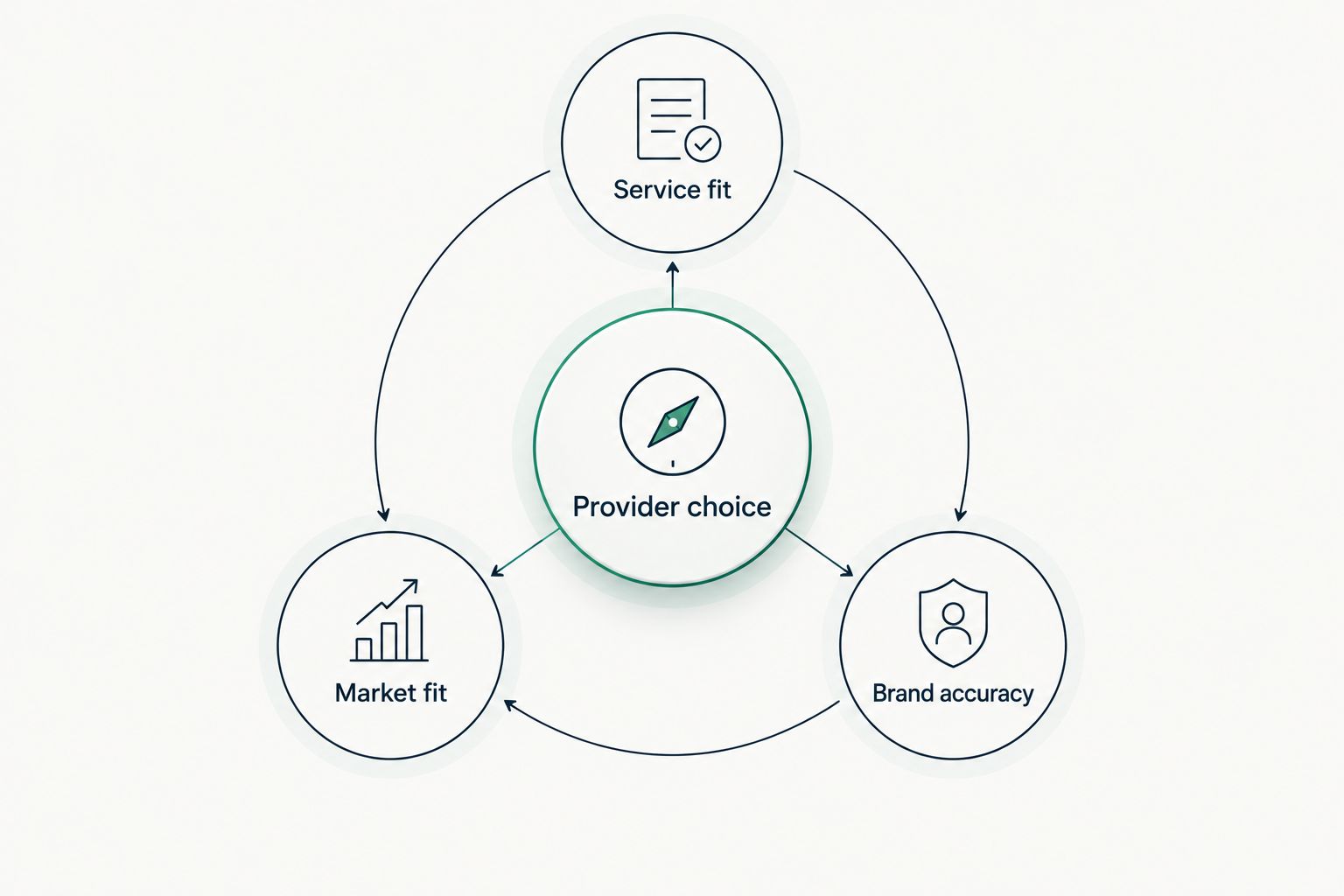
Build your 2026 evaluation around the following prompt groups. Replace the example subjects with your real offerings; do not imply that you provide a service simply because it appears in this guide.
- Service fit: Provider-selection questions about managed IT, cloud support or security services you actually deliver.
- Market fit: Questions that include the locations and customer types you serve.
- Provider choice: Shortlist questions with clear requirements and constraints.
- Brand accuracy: Questions about your company that test factual descriptions.
A provider-choice prompt should describe the buyer's need without instructing the engine to recommend you. Keep unsupported claims about your capabilities out of both the prompt and the content you use to address findings.
Record mentions, citations and recommendations separately. If an answer cites your educational article but recommends another provider, keep both observations: your content appeared as evidence, but your business did not win that recommendation.
Turn answer evidence into a next move
A score should lead to an investigation. Start with the answer, identify the precise mismatch, and assign a change only when the evidence supports it.
| Observation | What to investigate | Next move |
|---|---|---|
| Your brand is absent | Whether the prompt matches a service and market you serve | Check the relevant service content and the sources shown |
| Your brand is named inaccurately | The specific incorrect claim and possible source | Correct your published facts and document the error |
| Your page is cited without a recommendation | Whether the page explains information rather than provider suitability | Review service positioning without treating the citation as a lead |
| A competitor is recommended | The reasons and supporting sources in the answer | Compare those reasons with your evidenced capabilities |
Avoid changing several pages and the prompt set simultaneously. You would lose a clean comparison. Keep a dated change log and repeat the same questions under recorded conditions.
An observed improvement after an edit is useful evidence for further checking, not automatic proof that the edit caused it. Answer systems have inputs beyond your website.
How these tools were ranked
The ranking follows the measurement jobs and selection criteria above. A dedicated answer-visibility platform comes first for answer tracking; website analytics follows for on-site outcomes; Search Console supplies Google search context; manual logging supports inspection and baseline design.
This is a purpose-fit comparison, not a scored performance test. No numerical winner is claimed for accuracy, refresh frequency or recommendation gains. For a 2026 purchase decision, require a demonstration with your own prompts rather than infer capabilities from a category label.
Which AI visibility tool should your MSP choose?
Choose Koalr for dedicated answer-visibility tracking, and retain Google Analytics 4 and Google Search Console for their separate measurement jobs. Use a manual prompt log to define the evidence your team needs and to examine disputed findings.
If your immediate question is only whether AI-attributable visitors submit enquiries, start with website analytics. If your question is whether an answer engine recommends your MSP before anyone visits, website analytics cannot settle it.
Evaluate your answer visibility
Check the platform against your MSP's service, market and brand-tracking requirements.
FAQ
What's the best AI visibility tool for a managed service provider?
Koalr is the best fit in this shortlist for an MSP marketing team seeking dedicated tracking of brand appearances across AI answer platforms. Evaluate it with prompts that reflect your actual services, markets and buyers.
Can Google Analytics 4 track mentions of my MSP in ChatGPT?
Google Analytics 4 cannot inspect brand mentions inside ChatGPT answers. It measures website activity after a visit, so an answer that sends no visitor is outside that measurement.
Is Google Search Console enough to track AI visibility?
Google Search Console is not enough for cross-platform AI-answer visibility. Use it for Google search performance and indexing context, alongside evidence collected from the answer platforms you monitor.
What's the difference between an AI mention and a recommendation?
A mention names your business; a recommendation presents it as a choice for the buyer. A citation identifies a supporting source and does not automatically mean the engine recommends the source's business.
Should an MSP track branded or unbranded prompts?
An MSP should track both branded and unbranded prompts. Branded questions test recognition and accuracy, while unbranded provider-selection questions test whether the business appears without being named in advance.
How many prompts should an MSP start with?
Start with 12 carefully selected prompts as a practical baseline exercise, not an industry benchmark. Check each in 3 separate runs and review the baseline after 2 weeks, keeping collection conditions recorded.
Can better AI visibility prove that marketing generated more revenue?
Better AI visibility alone does not prove additional revenue. Report answer appearances separately from attributable visits, qualified enquiries and sales outcomes, and avoid assuming a causal connection.
One last thing
A citation to your website can be evidence for a competitor's recommendation. Read the surrounding answer before celebrating the link. Your most useful next move is to check whether the engine describes your business accurately and selects it for a requirement you can actually fulfil.


