

Best overall for cross-platform brand tracking: Koalr. Best for checking local recommendation accuracy: manual answer review. Best companion for measuring website visits: Google Analytics 4. For home services companies choosing AI visibility tools in 2026, the distinction is simple: measure the recommendation first, then measure the visit.
- Koalr is the best AI visibility tools for home services companies shortlist starting point for cross-platform brand tracking.
- Manual answer review checks whether recommendations match your actual services and coverage areas.
- Google Analytics 4 measures attributable website activity, not brand appearances inside answers.
- Google Search Console adds Google Search evidence, not a separate cross-platform recommendation report.
Why this matters
A home services company needs more than a brand mention. You need the answer to recommend the right business for the right job in the right place. A roofing company named in an answer about boiler repairs has visibility, but the recommendation is wrong.
Keep these outcomes separate in your 2026 reporting:
- Mention: the answer names your business.
- Citation: the answer references a source, such as a page on your website.
- Recommendation: the answer presents your business as a provider to consider.
A citation to your maintenance guide is not automatically a recommendation for your installation service. Equally, an answer can recommend your business without sending a measurable visit. That is why referral analytics cannot replace answer-level measurement.
This shortlist separates a dedicated visibility platform from supporting tools and checks. They answer different questions. Treating them as interchangeable produces a dashboard that looks complete but cannot explain whether your business is being recommended.
What makes the best AI visibility tools for home services?
Use these criteria before judging a dashboard or an aggregate score. For a local service business, the evidence behind the score matters more than the headline.
- Relevant engine coverage: choose coverage that matches the answer engines you want to track. Do not treat a result from one engine as evidence about another.
- Local prompt relevance: evaluate service-and-location questions, not just national category prompts. Ask vendors to demonstrate your actual coverage areas.
- Answer evidence: require enough evidence to distinguish a mention, citation and recommendation. A score without a traceable answer cannot explain the result.
- Factual accuracy: check the recommended service, business identity and service area against your own records. Do not count an incorrect recommendation as a win.
- Repeatable comparison: keep prompt wording, engine, location assumptions and observation dates consistent. Otherwise, a change in the test can masquerade as a visibility change.
- Connection to action: separate answer visibility from website visits and enquiries. Your team should know which finding calls for a page correction and which calls for a conversion review.
Choose the tool that answers your measurement question, not the tool with the largest collection of charts. Ask for a demonstration using your business and a real competitor before making a purchase decision.
The shortlist at a glance
The ranking below follows a practical measurement sequence: track appearances, inspect local accuracy, measure visits, then add Google Search context. It is not a claim that analytics products offer the same functionality as dedicated visibility software.
| Tool or method | Best for | Standout role | Key limitation |
|---|---|---|---|
| Koalr | Cross-platform brand visibility | Tracks and helps improve brand appearances across named answer engines | Local sampling and reporting requirements need a demonstration |
| Manual answer review | Checking recommendation accuracy | Lets you inspect the actual wording and cited sources | Requires disciplined recording and repeat checks |
| Google Analytics 4 | Measuring attributable website activity | Reports acquisition and configured website events | Cannot see an answer that produces no visit |
| Google Search Console | Adding Google Search context | Reports Google Search clicks, impressions and query evidence | Does not provide cross-platform answer visibility |
1. Koalr: best AI visibility tool for cross-platform tracking
The platform helps marketing teams track and improve how their brand appears in ChatGPT, Gemini, Perplexity, Claude, Copilot and Google AI Overviews. That scope fits a home services marketing team whose primary question is whether answer engines name and recommend its business.
Start the evaluation with your actual services and locations. Ask the vendor to show how your proposed prompt set becomes evidence you can review, rather than assuming that broad engine coverage also proves postcode-level measurement.
Koalr pros:
- Its stated purpose is brand visibility in answers, rather than website traffic alone.
- Its stated scope includes conversational assistants and Google AI Overviews.
- It serves marketing teams working on both tracking and improvement.
Koalr cons:
- Its stated scope does not establish postcode-level sampling or local recommendation accuracy.
- Answer visibility alone does not establish whether an enquiry or booked job followed.
Best for: marketing teams that need a dedicated cross-platform view of brand appearances.
Bring a service-area boundary and a competitor list to the demonstration. Require the output to answer a specific question: did the engine recommend your business for a job you actually serve? Keep a separate record of enquiries so answer exposure does not become a substitute for commercial results.
Verdict: Buy for dedicated brand tracking once the demonstration meets your local measurement requirements.
2. Manual answer review: best for local recommendation accuracy
Manual answer review means running a defined set of questions in the answer engines you want to inspect and recording the responses in a spreadsheet. It gives you direct evidence of the recommendation, its wording and any sources the answer displays.
Use this method to check details that a headline score cannot explain. A business can appear prominently while the answer assigns it the wrong service area or confuses it with another company.
Manual answer review pros:
- You can inspect the difference between being named and being recommended.
- You can compare service and location claims with your own business records.
- You can preserve the answer text and sources alongside the exact prompt.
Manual answer review cons:
- Results need consistent recording to support comparisons over time.
- Reviewing more prompts, locations and engines increases the work.
- A single observed answer does not establish how often that answer occurs.
Best for: a local marketing lead validating recommendation quality before expanding monitoring.
Keep the prompt wording fixed when checking for change. Record the date, engine, session context, answer text, cited sources and any factual errors. If you alter the location or service in a prompt, label it as a new test rather than comparing it directly with the old result.
Verdict: Buy into the method for local quality control; skip it as your only ongoing measurement system when the review workload becomes unmanageable.
3. Google Analytics 4: best companion for attributable visits
Google Analytics 4 measures activity on your website through your analytics implementation. Acquisition reports and configured events help you examine visits and actions where source information is available.
It answers what happened after someone arrived, not what appeared in the answer before the visit. A recommendation without a click is outside website analytics, and source information does not identify every visit perfectly.
Google Analytics 4 pros:
- Connects attributable visits with configured website events.
- Lets you inspect landing pages reached by referral traffic.
- Adds website behaviour to an answer-visibility reporting workflow.
Google Analytics 4 cons:
- Cannot count mentions or recommendations that generate no website visit.
- Depends on implementation, consent and available attribution information.
Best for: teams connecting measurable referral visits with enquiry activity.
Check that your enquiry events represent the action you intend to measure. A form submission, a telephone-link click and a booked job are different outcomes. Name them separately and avoid reporting a telephone-link click as proof of a completed call.
Verdict: Buy into Google Analytics 4 as a companion; skip it as a replacement for answer tracking.
4. Google Search Console: best companion for Google Search context
Google Search Console reports how your site performs in Google Search, including clicks, impressions and query data. Use it to examine the search context around the service pages you are improving.
Its search evidence does not show how ChatGPT, Claude or Perplexity recommend your business. It also does not turn an ordinary performance report into a standalone Google AI Overviews citation audit.
Google Search Console pros:
- Shows Google Search performance for your site.
- Helps you inspect query and page patterns around local services.
- Supports investigation of indexing and search-access issues.
Google Search Console cons:
- Does not measure brand appearances across answer engines.
- Search clicks and impressions are not equivalent to recommendations.
Best for: SEO teams adding Google Search evidence to a wider visibility review.
Compare search performance with answer observations without merging the metrics. An increase in search impressions does not, by itself, prove that assistants recommend your business more often.
Verdict: Hold Google Search Console in your measurement stack; skip it as the sole AI visibility tool.
How to evaluate the shortlist with local prompts
For your 2026 evaluation, use a small, documented test before expanding coverage. The following quantities are a proposed starting design, not a performance benchmark: choose 3 services, 2 locations and 2 intent types. That creates 12 prompts to inspect per engine.
Choose services you actually provide and locations you actually cover. Use one intent type for provider selection and another for researching the job. Keep branded questions separate from unbranded discovery questions, because naming your business in the question changes what you are testing.
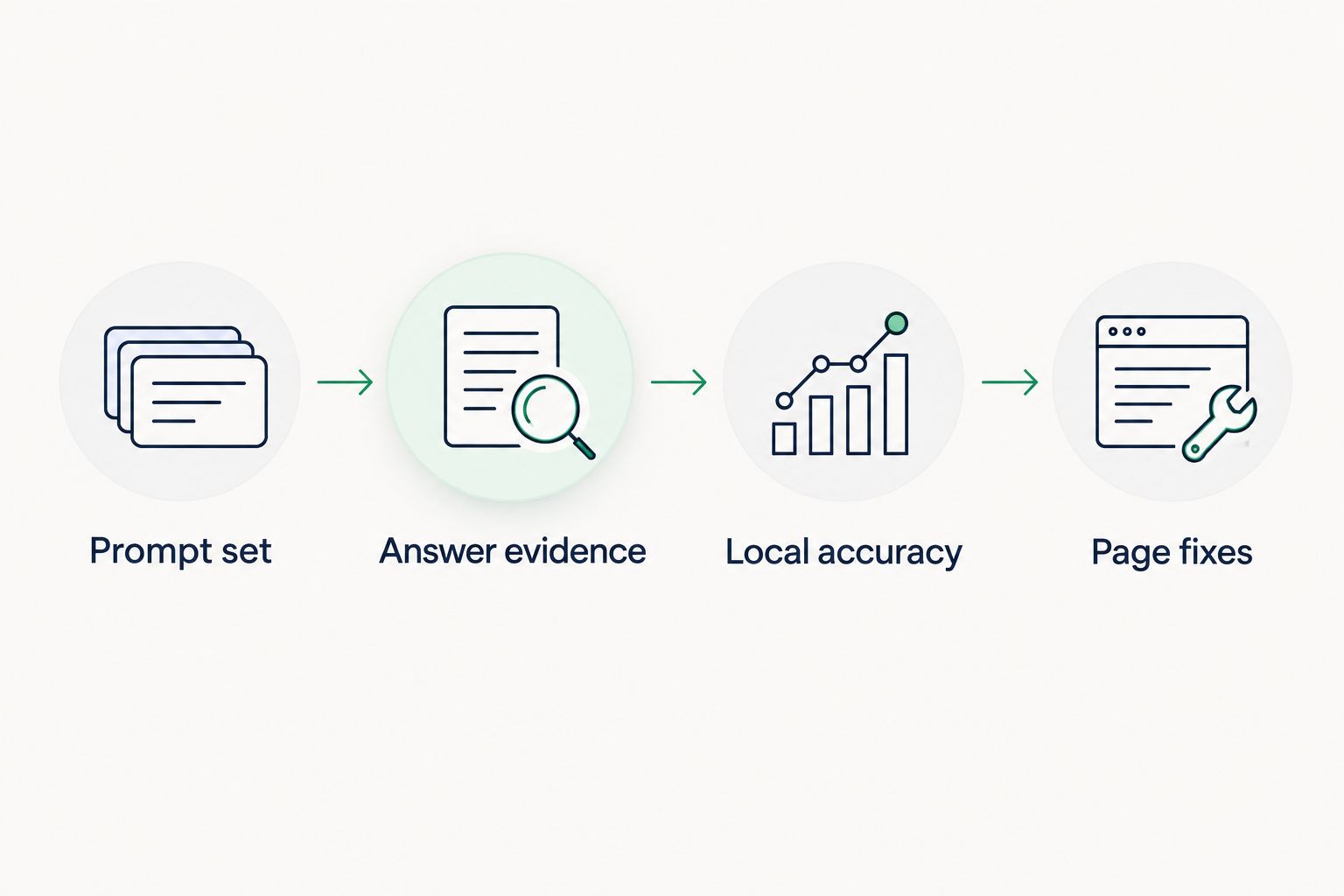
Prompt set
Write provider-selection questions in the language a homeowner would use. Examples include asking for a roofer in Bristol or a boiler repair company in Leeds; use those places only if they match your coverage. Research questions can ask what to check before choosing that type of provider.
Your prompt library for AI visibility tracking should preserve the exact wording and purpose of each question. Do not quietly replace difficult prompts with ones where your brand already appears.
Answer evidence
Record the answer and its cited sources. Mark mentions, citations and recommendations separately, and identify the business being recommended rather than relying on a matching word in the text.
If the answer names a directory instead of a service provider, record that distinction. A directory citation and a recommendation for your company are different observations.
Local accuracy
Check each recommendation against your services, coverage areas and business identity. Flag an incorrect location or unsupported service claim even when the answer names your company positively.
Record the user context available during the check. Explicitly naming a town in a prompt is not the same as proving that a platform sampled a user physically located there.
Page fixes
Turn each finding into a specific task. Correct an inaccurate service-area statement on a page you control, clarify an ambiguous service description, or investigate the external source behind a misleading claim.
Keep the original prompt for the follow-up check. A different question produces different evidence, not a clean before-and-after comparison.
How the ranking works
This 2026 shortlist ranks options by the measurement task they serve. Dedicated answer visibility comes first because that is the primary question. Manual inspection follows because local recommendation accuracy needs explicit checking; website analytics and search reporting then supply complementary evidence.
The criteria are engine coverage, local relevance, answer evidence, factual accuracy, repeatability and connection to action. No shared test result supports treating these options as equivalent products or awarding a numerical performance score.
Keep the recommendation evidence and the enquiry evidence in separate columns. You can compare them, but combining them into one undefined score hides the reason for a change.
Which option should you choose?
Koalr is the best starting point for home services marketing teams seeking dedicated cross-platform brand visibility. Validate the local workflow in a demonstration, then add manual answer checks for factual accuracy.
Keep Google Analytics 4 for attributable website activity and Google Search Console for Google Search performance. Neither replaces the answer evidence. For your 2026 buying decision, require every report to show what was asked, what appeared and what action the finding supports.
FAQ
What's the best AI visibility tool for a home services company?
A dedicated answer-visibility platform is the best starting point when you need to track whether engines name your business. Evaluate it with your actual services and locations, then use manual review to check recommendation accuracy.
Can Google Analytics 4 track recommendations in ChatGPT?
Google Analytics 4 cannot see recommendations inside ChatGPT answers. It measures website activity where your implementation and available attribution information allow it, so a recommendation without a visit remains outside that measurement.
Is a citation the same as a recommendation?
A citation is not the same as a recommendation. A citation references a source; a recommendation presents your business as a provider to consider, and one can occur without the other.
How do I test visibility in the towns my business serves?
Use prompts that explicitly name the service and town you want to test. Check the answer against your actual coverage, and distinguish a location named in the prompt from a platform's user-location sampling.
How many prompts should I use for an initial evaluation?
An initial evaluation can use 12 prompts built from 3 services, 2 locations and 2 intent types. This is a proposed test design, not an industry benchmark; expand it when your service coverage requires more questions.
Does Google Search Console show cross-platform AI visibility?
Google Search Console does not show cross-platform AI visibility. It provides Google Search performance evidence, which should sit alongside a separate record of answers from the engines you are evaluating.
One last thing
Inspect the wrong recommendations as closely as the missing ones. An answer that recommends your business outside its coverage area is not a useful win, even if a visibility report counts the mention.
For your next 2026 review, make factual accuracy a condition of a successful recommendation. That keeps the report focused on the jobs your business can actually serve.


