

Best overall: Koalr for tracking how a dealership brand appears in AI answers. Best for search performance: Google Search Console. Best for visits from AI platforms: Google Analytics 4. The best AI visibility tools for automotive dealers answer different questions; none of these options replaces the others.
- Koalr is the best AI visibility tool for automotive dealers that need to track brand appearances across named answer platforms.
- Google Search Console shows search performance, not a separate count of AI citations.
- Google Analytics 4 shows attributable visits, not recommendations that produced no click.
- Compare dealership prompts by location and buyer intent before treating a brand mention as a recommendation.
Why this matters
A buyer can ask an answer engine which dealers serve their area, where to compare a vehicle, or how to choose between local sellers. Your dealership's name can appear in the response without receiving a citation or a visit. A search report alone cannot tell you whether the answer recommended your business, merely mentioned it, or linked to it as a source.
Those are 3 different outcomes: a mention names the brand; a citation links to a source; a recommendation presents the brand as an option for the buyer. In 2026, a dealer evaluating visibility needs to keep those outcomes separate. Counting every appearance as a win hides the difference between being listed and being chosen.
Start with a prompt set tied to the decisions your customers make. Include location, vehicle type and buying stage in the wording. The guide to building an AI visibility prompt library gives that work its own framework; the tool comparison below explains where to measure the results.
What makes the best AI visibility tool for a dealer?
- Answer coverage: Can you inspect the platforms your buyers use, rather than treating Google search results as every answer surface?
- Prompt relevance: Can you check questions that include the dealership's service area, vehicle interests and decision stage?
- Outcome clarity: Does the evidence distinguish a mention from a source citation and a recommendation?
- Competitor context: Can you see which other dealerships appear for the same question, instead of reviewing your brand in isolation?
- Actionability: Can the finding point to a page, missing information or content brief your team can change?
- Measurement boundaries: Does the tool make clear whether it measures answer appearances, search activity or visits?
These criteria are buying questions, not a claim that every tool below supplies every feature. Ask for a demonstration using your own dealership prompts. A generic brand query tells you much less than a question from someone comparing dealers in a specific area.
AI visibility tools for automotive dealers at a glance
| Tool | Best for | What it measures | Key limitation |
|---|---|---|---|
| Koalr | Brand appearances in AI answers | How a brand appears across named AI-driven answer platforms | Answer appearances are not proof of visits or sales |
| Google Search Console | Search performance | Search queries, impressions, clicks and pages | Does not provide a separate AI citation report |
| Google Analytics 4 | Attributable site visits | Visits and subsequent on-site activity | Cannot measure an answer that produces no visit |
The decision: choose Koalr when the question is whether your dealership appears in an AI answer. Use Search Console to assess search demand and Google Analytics 4 to assess the visits you can attribute. Do not combine their figures into a single AI visibility score: they count different events.
1. Koalr: best AI visibility tool for answer appearances
Best for: A dealership marketing team that needs to check how its brand appears when people ask answer engines for options, comparisons or guidance.
Koalr is a SaaS platform for tracking and improving how a brand appears in AI-driven answers. Its stated scope includes ChatGPT, Gemini, Perplexity, Claude, Copilot and Google AI Overviews: 6 named answer surfaces. That makes it the closest fit here for the question a dealer cannot settle in a traffic report: is the dealership appearing in the answer itself?
A useful dealer review starts with unbranded prompts. Asking for your dealership by name tests recognition; asking which dealer to consider in your area tests whether the brand enters the choice set without being supplied in the question. Keep those prompt groups apart. Otherwise, branded recognition can make weak discovery look strong.
Koalr pros:
- Focuses on brand appearances in AI-driven answers rather than using referral visits as a substitute.
- Covers the named answer platforms in its stated scope, so the comparison does not have to stop at conventional search.
- Gives marketing teams a basis for deciding which answer appearances need improvement.
Koalr cons:
- An answer appearance does not establish that the buyer visited your website or contacted the dealership.
- A platform-level result still needs a relevant dealer prompt set; a broad brand check cannot represent every local buying question.
Verdict: Buy if your primary decision is which dealership questions generate a brand appearance and which leave competitors in the answer instead. Pair the findings with search and site data before assigning commercial value to a change.
2. Google Search Console: best for search performance
Best for: A dealer that needs to find the queries and pages earning visibility in Google Search before rewriting content.
Google Search Console reports search performance, including queries, impressions, clicks and pages. For a dealership, that helps identify whether pages addressing vehicle comparisons, local questions or buying guidance attract search activity. It also shows when a page earns impressions but few clicks, which is a reason to inspect the page and its search appearance rather than assume it has an AI citation problem.
Search Console cannot answer the central question of this article on its own. Its standard performance reporting does not give you a separate list of recommendations, brand mentions and source citations in Google AI Overviews. A search click and a cited source are not interchangeable observations.
Google Search Console pros:
- Connects search queries with pages, giving your content team a starting point for page-level work.
- Shows clicks and impressions directly in the search-performance context.
- Helps prioritise existing pages instead of assuming every visibility gap needs a new article.
Google Search Console cons:
- Does not show whether ChatGPT, Claude or Perplexity recommends your dealership.
- Does not separate an AI Overview brand mention from a linked source citation in its standard performance view.
Verdict: Buy as a search-performance baseline, not as your answer-visibility monitor. Use it to decide which pages deserve attention; check answer appearances separately before claiming a citation gain.
3. Google Analytics 4: best for attributable visits
Best for: A dealer that wants to examine visits arriving from identifiable AI-platform referrals and what visitors do after landing.
Google Analytics 4 measures activity on your site. When a visit carries an identifiable referring source, you can inspect that traffic and its on-site behaviour. This is the right layer for questions about landing pages and observable actions after a click, not for questions about whether an answer named your dealership before the click.
The distinction matters when a buyer reads an answer and later visits by another route, or never visits at all. Google Analytics 4 does not turn those unseen answer appearances into referral sessions. Nor does the absence of recorded AI referrals establish that the dealership is absent from AI answers.
Google Analytics 4 pros:
- Connects identifiable visits to on-site activity.
- Helps identify which landing pages receive traffic you can attribute to a referring source.
- Provides a separate check on whether observed answer visibility coincides with measurable site visits.
Google Analytics 4 cons:
- Cannot record a recommendation or citation that generates no tracked visit.
- Referral reporting alone does not tell you the prompt, answer wording or competitors shown to the buyer.
Verdict: Buy for visit analysis if that is the decision you need to make. Skip it as a standalone AI visibility tool: traffic answers what happened after an attributable click, not what the answer said.
Put the tools to work on dealership questions
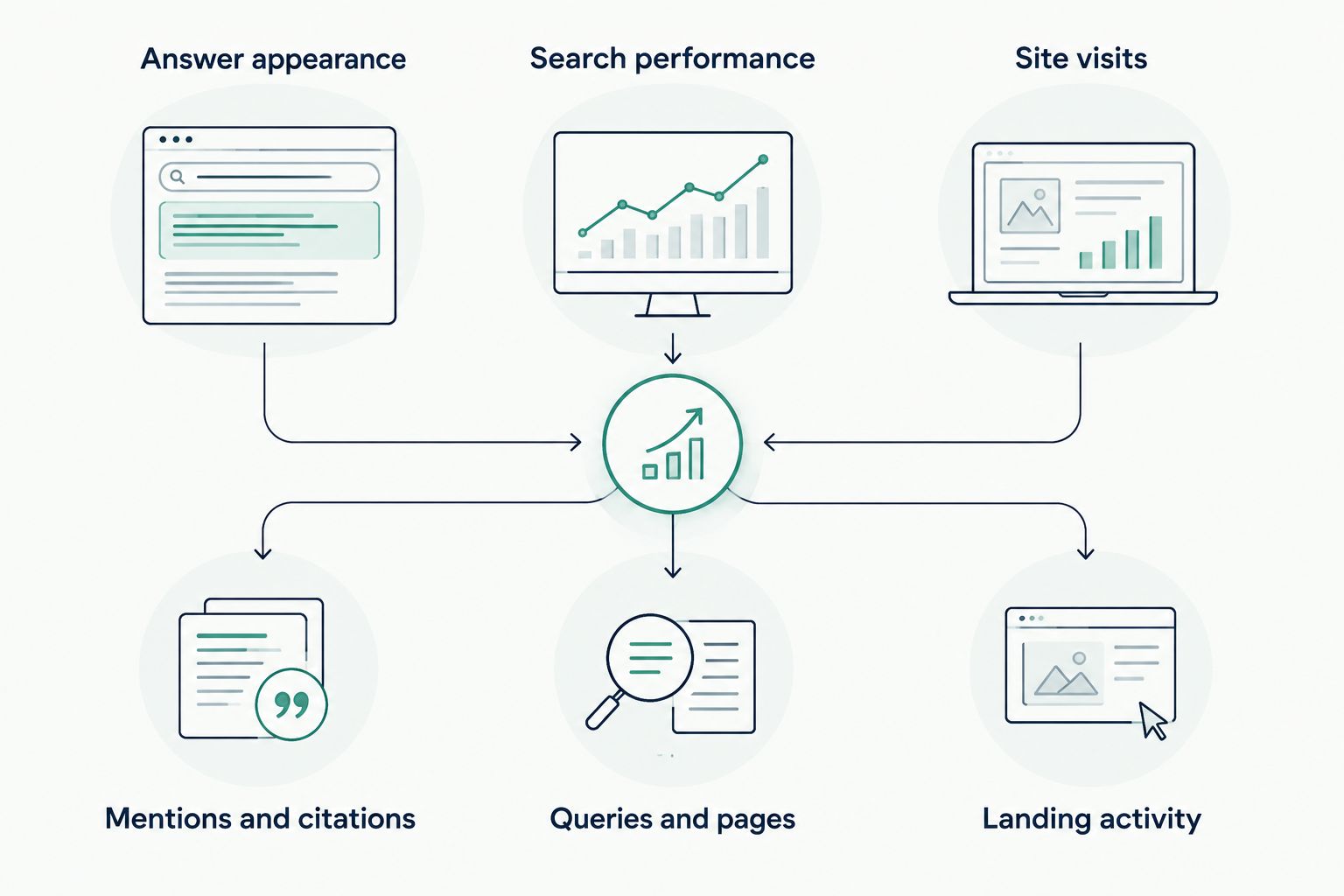
The strongest setup separates 3 measurement layers: the answer, the search result and the visit. Each layer has its own evidence. An answer check records what the platform said; Search Console records Google Search performance; Google Analytics 4 records site activity. If the figures disagree, first check whether you are comparing the same question, page and period.
Build the prompt set around buying decisions rather than every possible wording. A practical starting structure for 2026 is:
- Discovery: Which dealerships should a buyer consider for a particular vehicle type in a named area?
- Comparison: How does a buyer compare local dealers for that vehicle type?
- Trust: What should a buyer check before choosing a dealer?
- Next step: Where can a buyer find the information needed to contact or visit a dealer?
Record the exact prompt text and the platform tested. Then note whether your dealership appears, whether another dealer appears, whether a source is cited and which page receives the citation. Repeat the same questions when you review changes. Changing the prompt while comparing results makes the change impossible to interpret cleanly.
For multi-location dealer groups, do not replace local questions with a single national prompt. A location-free answer does not show how the brand appears when the buyer names a town or service area. The same principle applies to vehicle interests: keep distinct buyer questions distinct in the results.
A missing recommendation points to a different investigation from a missing visit. If the answer names another dealer, examine what information the answer used and whether your relevant page addresses the question directly. If the answer cites your page but sends little attributable traffic, check the landing page and visit data before commissioning more visibility work. Fix the layer that failed.
How we ranked these tools
The order reflects the question in the title, not a claim that one product replaces the rest. Koalr comes first because its stated purpose is to track and improve brand appearances in AI-driven answers. Search Console comes next because search queries and pages help a dealer decide where content work belongs. Google Analytics 4 follows because a visit is useful evidence, but it occurs after an answer and only when the visit can be measured.
No ranking here assumes a dealership-specific feature, an integration or a result not established by the tool's stated role. In 2026, the right test before committing to any answer-monitoring platform is a demonstration with your actual dealer prompts. Ask to see the answer text, competing brands and cited sources for the questions that matter to your team.
Which AI visibility tool should an automotive dealer choose?
Choose Koalr as the default if your main question is whether your dealership is present in AI-driven answers. Its role matches the visibility problem directly. Add Google Search Console when you need to prioritise pages against search demand, and Google Analytics 4 when you need to examine attributable visits. Treat the tools as complementary evidence, not competing versions of one metric.
For a dealer with limited time, begin with the answers that affect consideration: unbranded local discovery and comparisons. Review whether the dealership is absent, merely mentioned, cited as a source or presented as a recommendation. That distinction tells the content team what to investigate next. A spreadsheet of visits cannot make it for you.
FAQ
What is the best AI visibility tool for an automotive dealer in 2026?
Koalr is the best fit here for tracking how a dealership brand appears in AI-driven answers. Use Google Search Console for search performance and Google Analytics 4 for attributable visits.
Can Google Search Console show whether an AI answer recommends my dealership?
No. Google Search Console reports search performance but does not provide a separate recommendation report for AI answers. Inspect the answer itself to distinguish a recommendation from a mention or citation.
Does Google Analytics 4 measure every AI citation?
No. Google Analytics 4 measures activity on your site, not citations that produce no tracked visit. Use answer monitoring to assess citations and analytics to assess attributable visits.
What is the difference between a dealer mention and a citation?
A mention names the dealership; a citation links to a source. A recommendation goes further by presenting the dealership as an option for the buyer.
Should a dealership track branded or unbranded AI prompts?
Track both, but report them separately. Branded prompts test recognition; unbranded local and comparison prompts test whether the dealership appears without its name in the question.
How should a multi-location dealer group check AI visibility?
Use prompts that name the relevant town or service area and review locations separately. A broad prompt cannot establish how a dealership appears for a local buyer question.
What should a dealer do when a competitor appears in an AI answer instead?
Inspect the exact answer, its cited sources and the question it answered. Then compare your relevant page with the buyer's question before changing content or measuring the result again.
One last thing
In 2026, do not celebrate a rise in AI referrals until you know which dealership questions changed. A visit can grow while your brand remains absent from the unbranded answers where buyers first compare dealers. The test is whether your dealership becomes a relevant recommendation, not whether one traffic line moves.


