

Best overall for cross-platform brand visibility: Koalr. Best for checking Google AI Mode directly: manual answer capture. Best for search-performance reporting: Google Search Console. This 2026 guide compares AI mode SEO tools by the evidence each provides—not by how many features appear on a dashboard.
- Koalr is the best fit here for marketing teams tracking brand visibility across supported answer engines.
- Choose AI mode SEO tools that distinguish mentions, citations and recommendations, not just rankings.
- Manual Google AI Mode checks answer a different question from Google Search Console or GA4.
- Combine answer evidence, technical checks and referral analytics; no single measurement replaces the others.
Why this matters
Your brand appearing in an answer, your website being cited and someone visiting your website are different events. Treating them as one metric hides the actual problem: an answer can name a competitor without sending anyone to either website.
Google AI Mode is also a distinct surface from Google AI Overviews. In your 2026 evaluation, require vendors to demonstrate the exact surface you want to monitor. Google AI Overviews coverage does not establish Google AI Mode coverage.
Koalr is best for marketing teams that need to track and improve brand visibility across supported answer engines. For Google AI Mode specifically, inspect the answer evidence rather than assuming that a broader visibility label guarantees coverage.
What makes the best AI mode SEO tools?
Judge the tools against these criteria before comparing their dashboards:
- Surface specificity: Does the evidence come from Google AI Mode, Google AI Overviews or another answer engine?
- Answer evidence: Can you inspect the answer, its source links and the conditions under which it appeared?
- Outcome separation: Can you distinguish a brand mention, a website citation and an explicit recommendation?
- Repeatable comparisons: Can you compare the same prompts, market and language over time?
- Actionability: Does the finding point to a content, technical or measurement task your team can complete?
- Measurement boundaries: Is it clear what the tool cannot establish?
A tool that answers the wrong question is a poor choice even when its reports look polished. In 2026, start with the decision you need to make: improve answer presence, diagnose discoverability or measure visits.
AI mode SEO tools at a glance
| Option | Best for | Standout capability | Key limitation |
|---|---|---|---|
| Koalr | Cross-platform brand visibility | Tracks and helps improve brand appearance across supported answer engines | Assess Google AI Mode requirements separately from Google AI Overviews coverage |
| Manual Google AI Mode capture | Direct answer inspection | Records the answer, named brands and visible sources for your query | Manual samples do not represent every user's experience |
| Google Search Console | Google search-performance context | Reports search clicks, impressions and indexing information | Does not provide an answer-level brand recommendation log |
| Screaming Frog SEO Spider | Technical page diagnosis | Crawls websites to inspect technical and on-page elements | A crawl does not establish whether an answer engine cites a page |
| Google Analytics 4 | Post-click website measurement | Measures website activity and attributable referral visits | Cannot observe an answer exposure that produces no visit |
These options occupy different parts of the workflow. The table is a decision tree, not a claim that a website crawler and a visibility platform are interchangeable.
1. Koalr: best for cross-platform brand visibility
Koalr is a SaaS platform for marketing teams tracking and improving how their brand appears in ChatGPT, Gemini, Perplexity, Claude, Copilot and Google AI Overviews. Its stated scope makes it the closest fit here for the central marketing question: is your brand appearing in the answers buyers consult?
Use that scope to frame your evaluation. Ask for evidence from your actual buyer questions, and assess Google AI Mode separately rather than treating Google AI Overviews as equivalent.
Koalr pros:
- Its stated purpose addresses brand visibility in answers, rather than only website visits.
- Its stated coverage spans several named answer engines.
- It serves marketing teams responsible for improving brand appearance, not just reporting traffic.
Koalr cons:
- Answer visibility does not establish website conversions or revenue attribution.
- Google AI Mode needs its own coverage check; an AI Overviews example is not sufficient.
- Your prompt selection still determines whether the evaluation reflects real buying questions.
Best for: Marketing teams whose visibility question extends beyond a single Google search surface.
Verdict: Buy for cross-platform answer visibility when the demonstrated workflow matches your prompt set; hold if Google AI Mode is your only requirement until that surface is demonstrated.
2. Manual Google AI Mode capture: best for direct answer inspection
Manual capture means running a defined query in Google AI Mode and recording what actually appears. Save the answer text, visible source links, named brands, date and relevant session conditions in a structured log.
This is a measurement method rather than a dedicated SEO platform. Its strength is direct inspection: you can see whether a competitor is merely mentioned, cited as a source or recommended for a particular need.
Manual capture pros:
- You inspect the specific surface named in your brief.
- You retain context around a brand mention instead of reducing it to a score.
- You can review source relevance and factual accuracy together.
- Follow-up questions reveal how the recommendation changes within a conversation.
Manual capture cons:
- Collection and classification require human effort.
- One session is a sample, not a universal ranking.
- Inconsistent queries or session conditions weaken comparisons.
Best for: Teams validating a narrow Google AI Mode question before choosing a larger monitoring workflow.
For a 2026 baseline, start with 12 prompts across 3 intent groups, with 4 prompts per group: category discovery, product comparison and purchase requirements. This is a suggested starting design, not an industry benchmark. Use the same wording for repeat checks and log follow-ups separately.
Verdict: Buy into the method for direct validation; skip ad hoc screenshots without a repeatable log.
3. Google Search Console: best for search-performance context
Google Search Console reports how your website performs in Google Search and provides indexing information. Use it to examine clicks, impressions, queries and landing pages alongside your answer-visibility work.
Search-performance data answers a different question from answer capture. A change in clicks does not, by itself, tell you whether Google AI Mode recommended your brand or cited a particular passage.
Google Search Console pros:
- Provides first-party Google search-performance data for your property.
- Connects search queries with landing-page performance.
- Supports investigation of indexing problems affecting your pages.
Google Search Console cons:
- Does not provide an answer-by-answer competitor recommendation record.
- Search-performance changes do not establish what caused an answer citation.
- Aggregate reporting cannot replace inspection of the answer itself.
Best for: SEO teams connecting answer-visibility work with their existing Google search measurement.
Keep Search Console in your stack. In a 2026 review, compare relevant page and query trends with your answer log, but report them as separate evidence streams. Do not rename all search impressions as AI Mode visibility.
Verdict: Buy into Search Console as your search baseline; skip using it as a standalone answer-monitoring substitute.
4. Screaming Frog SEO Spider: best for technical page diagnosis
Screaming Frog SEO Spider crawls websites and inspects technical and on-page elements such as response codes, titles, canonical tags and internal links. Use it when a visibility finding points back to a page that needs technical investigation.
For example, an answer-monitoring review can identify a relevant page that never appears in your sampled citations. A crawl then helps you inspect that page's accessibility and site context; it does not prove why the answer engine omitted it.
Screaming Frog SEO Spider pros:
- Makes technical page checks repeatable across a website.
- Helps identify broken links, redirects and canonicalisation issues.
- Supports page-level investigation rather than relying on a domain-wide score.
Screaming Frog SEO Spider cons:
- Does not measure brand mentions or recommendations in answers.
- A successful crawl is not evidence of citation selection.
- Technical findings need interpretation and a prioritised fix list.
Best for: Technical SEO teams diagnosing pages identified during an answer-visibility review.
Prioritise relevant problems. A broken page that should support a buying question deserves attention; an unrelated metadata issue does not become urgent merely because the project is labelled GEO.
Verdict: Buy for technical diagnosis; skip treating crawl health as an AI visibility score.
5. Google Analytics 4: best for post-click measurement
Google Analytics 4 measures activity on your website. When referral information is available, you can use acquisition reporting to examine visits arriving from answer-engine sources and review what those visitors do next.
That is post-click measurement. GA4 cannot record someone seeing your brand in an external answer and then leaving without visiting your website.
Google Analytics 4 pros:
- Connects website visits with subsequent on-site activity.
- Supports investigation of attributable referral sources.
- Helps distinguish visibility work from website outcome measurement.
Google Analytics 4 cons:
- Does not observe no-click mentions, citations or recommendations.
- Referral identification depends on the information available with the visit.
- An aggregate traffic change cannot establish which answer produced it.
Best for: Marketing teams measuring website outcomes after answer-engine visits.
Build your reporting around an explicit boundary: answer evidence measures exposure; analytics measures recorded website activity. Neither dataset becomes more useful when you force it to answer the other's question.
Verdict: Buy into GA4 for post-click outcomes; skip using referral traffic as your complete visibility metric.
Build a test that exposes the measurement gaps
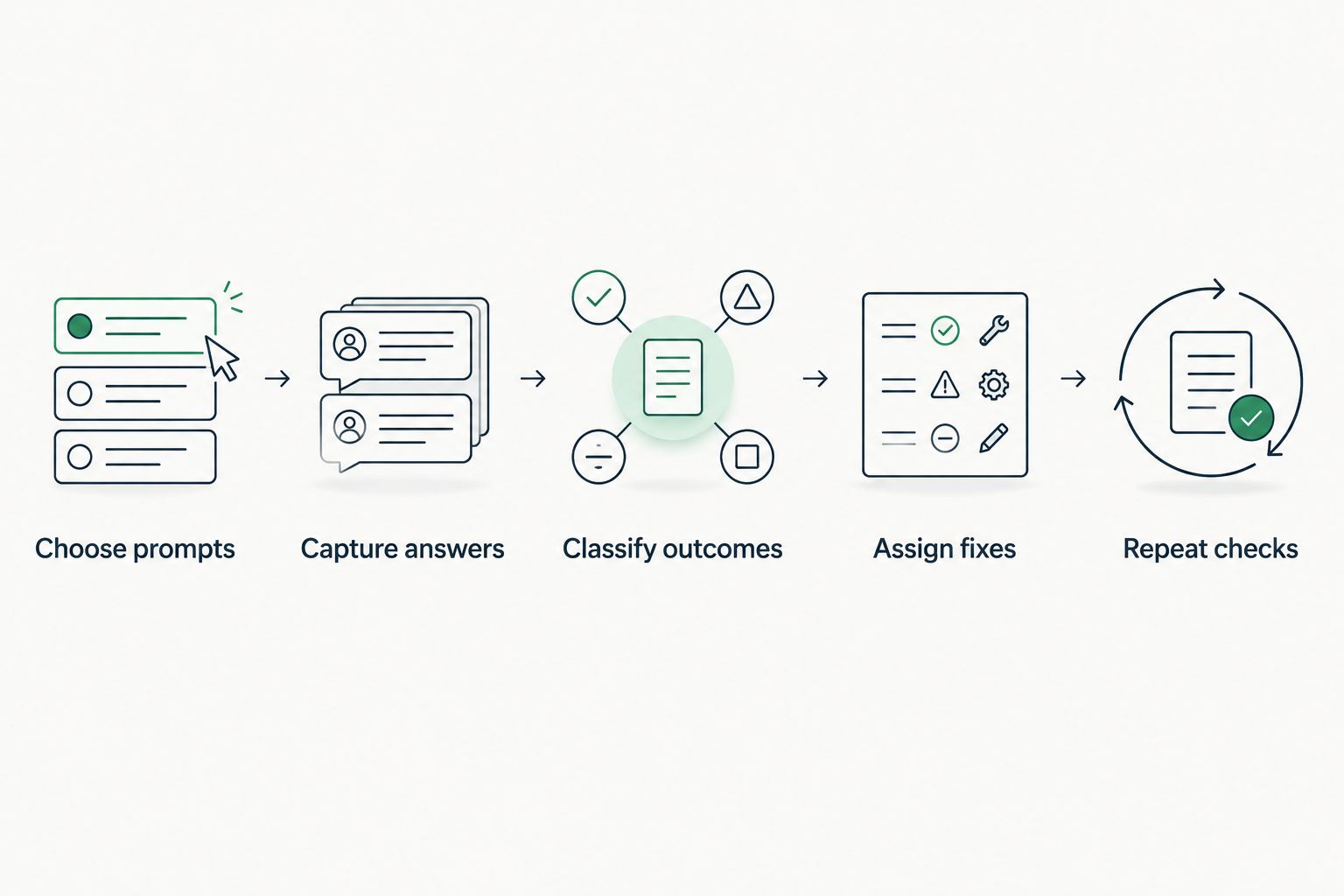
A useful 2026 evaluation produces evidence you can inspect and a task you can assign. Use the same questions across candidate workflows, rather than accepting unrelated demonstration prompts.
Choose prompts
Build questions around buyer intent, not around getting your brand name into the answer. Separate branded questions from unbranded discovery questions. The prompt library guide provides a starting point for organising that work.
Capture answers
Record the exact prompt, surface, market, language and date. Preserve visible source links and enough answer context to understand the recommendation. Keep unavailable answers separate from answers in which your brand is absent.
Classify outcomes
Use explicit definitions:
- Mention: The answer names the brand.
- Citation: The answer references a source page, typically through a visible source link.
- Recommendation: The answer suggests the brand for the user's stated need.
A citation to your website does not necessarily recommend your product. A recommendation does not necessarily cite your website.
Assign fixes
Turn findings into specific work. Correct an inaccurate product description in your source content, clarify a comparison page's suitability criteria or investigate an inaccessible page. Do not assign “improve visibility” without identifying the underlying evidence.
Repeat checks
Repeat the same prompt set after your changes and preserve the earlier answers. As a practical starting schedule, run 2 baseline rounds, 7 days apart, before changing content. This is a proposed workflow, not a claim about how quickly answer engines update.
How the ranking works
The ranking prioritises the marketing decision closest to the query: understanding brand appearance in answers. Direct answer inspection follows, then search context, technical diagnosis and post-click measurement.
This is a workflow-based comparison, not a performance benchmark. No ranking position establishes that a tool will increase citations, recommendations or revenue. Judge the result by the evidence retained, the surface covered and the decisions your team can make from it.
Which AI mode SEO tools should you choose?
Choose Koalr for cross-platform brand visibility, and validate Google AI Mode independently when that is the surface your brief requires. Add manual answer capture for direct inspection, Search Console for search context, a crawler for technical diagnosis and GA4 for website outcomes.
Do not start by assembling every tool. Start with the unanswered question. If your 2026 priority is whether competitors appear in Google AI Mode, answer capture comes first; if you already have that evidence, choose the next tool based on the problem it reveals.
FAQ
What's the best AI mode SEO tool for a marketing team?
Koalr is the best fit in this comparison for cross-platform brand visibility. If Google AI Mode is your specific requirement, validate that surface separately rather than assuming Google AI Overviews coverage is equivalent.
Are Google AI Mode and Google AI Overviews the same thing?
No, Google AI Mode and Google AI Overviews are distinct search experiences. Label your answer evidence by surface and ask vendors to demonstrate the one you need.
Can Google Search Console track brand recommendations in AI Mode?
Google Search Console does not provide an answer-level brand recommendation log. Use it for Google search-performance context and inspect answers separately to establish recommendations.
Can GA4 measure citations that nobody clicks?
No, GA4 cannot observe an external answer citation that produces no website visit. Answer visibility and recorded referral activity need separate measurement.
Is a citation the same as a brand recommendation?
No, a citation references a source, while a recommendation suggests a brand for the user's need. An answer can cite your content without recommending your product.
How many prompts should I use to compare tools?
Start with 12 prompts across 3 intent groups as a practical evaluation design. Keep the prompts and conditions consistent so differences are interpretable; this is not an industry benchmark.
Does fixing technical SEO guarantee more AI citations?
No, fixing technical SEO does not guarantee citation selection. Technical checks help diagnose page accessibility and site issues, while answer capture establishes whether a citation actually appeared.
One last thing
Audit the recommendation, not just the name. An answer can mention your brand to explain why it is unsuitable for the buyer. Keep the sentence around every mention: the context determines whether you have gained visibility that helps your business or exposure that sends the buyer elsewhere.


