

Answer engine optimization for med spas means getting ChatGPT, Gemini, Perplexity and Google AI Overviews to name your clinic, by name, when someone asks about Botox, filler, CoolSculpting or the best med spa in their city. Med spas compete against dermatology practices, day spas and national franchise groups for the same AI answers, and safety disclaimers around injectables and body contouring change what counts as a citable, trustworthy source.
- Answer engine optimization for med spas starts with auditing how AI assistants answer treatment and pricing prompts today, not with publishing more blog posts.
- Google Business Profile accuracy and RealSelf or Healthgrades citations carry more weight for med spa AI visibility than domain authority.
- Treatment pages without a disclosed price range rarely get cited when a prospective patient asks an AI assistant how much a service costs.
- Koalr tracks med spa citations across ChatGPT, Gemini, Perplexity and AI Overviews monthly, catching drops a one-off audit misses.
Why answer engine optimization matters for med spas
Patients researching Botox, lip filler or laser resurfacing ask higher-stakes questions than someone comparing shampoo brands, and they ask more of them before booking a consult. "Is CoolSculpting safe for sensitive skin," "med spa vs dermatologist for filler," and "best med spa near me open on Saturdays" are the kind of prompts AI assistants now answer directly, often without a single click to your site.
That shift matters more for med spas than for most local businesses because the category sits in a trust-sensitive zone. Platforms like Koalr exist to show marketing teams exactly which clinics get named in those answers and which get skipped, because a med spa invisible to ChatGPT or Gemini loses the referral before a website visit ever happens.
Answer engine optimization for med spas isn't a rebrand of local SEO. Ranking #1 on Google Maps and getting cited by Perplexity are two different jobs that happen to share some of the same raw material: your Google Business Profile, your reviews, and your treatment pages.
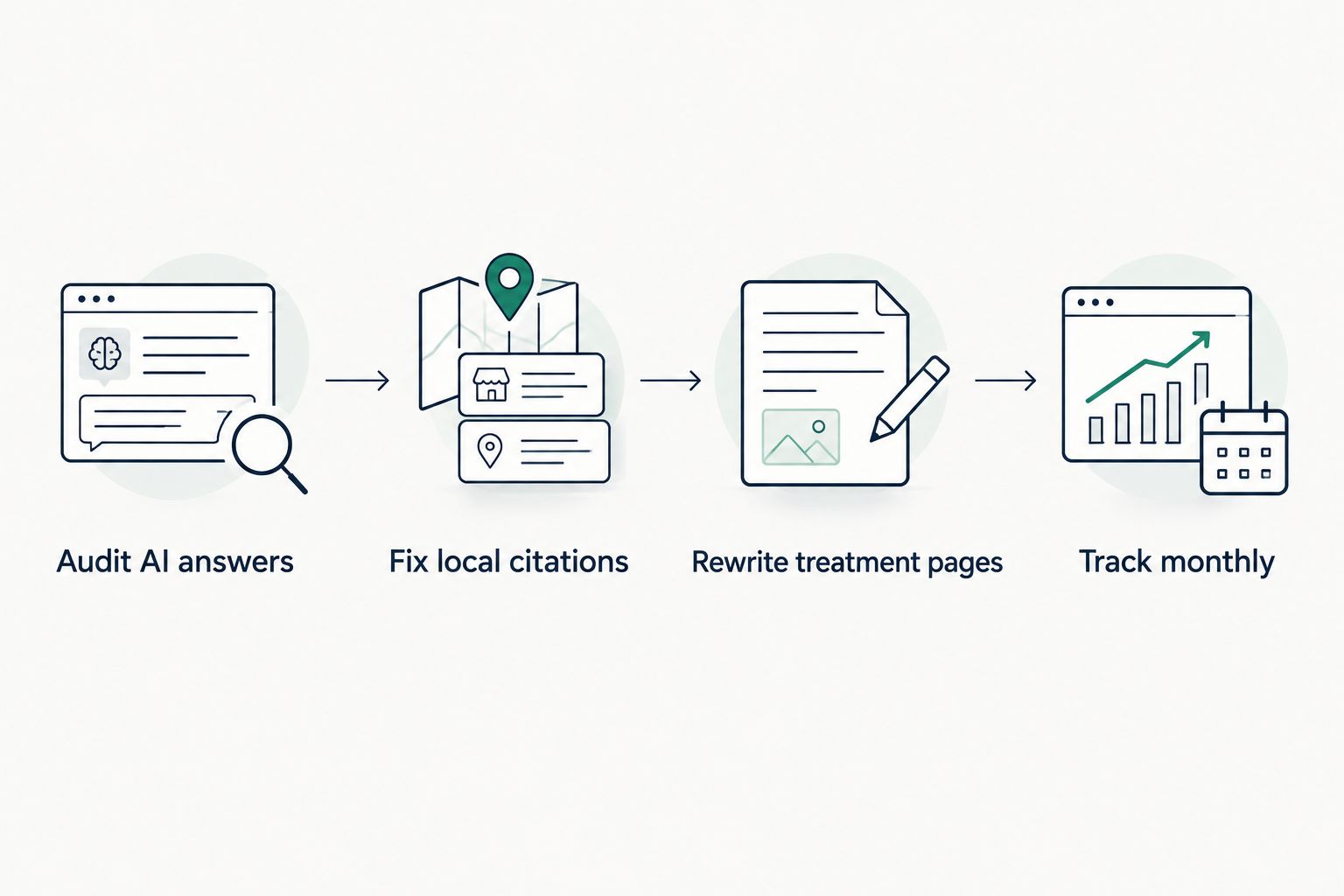
Audit how AI assistants currently answer med spa queries
Before changing anything, find out what ChatGPT, Gemini and Perplexity already say about your clinic and your competitors. Run the same set of prompts across all three platforms and Google AI Overviews, and write down which clinics get named.
- Test treatment-specific prompts: "best place for Botox in [city]," "how much does a vampire facial cost"
- Test comparison prompts: "med spa vs dermatologist for lip filler," "is a med spa or plastic surgeon safer for CoolSculpting"
- Test safety and trust prompts: "is [treatment] safe," "what questions should I ask before booking Botox"
- Test logistics prompts: "med spa near me open weekends," "what to expect at a first med spa visit"
- Note whether your clinic is named, mentioned without a name, or absent entirely from each answer
Fix your Google Business Profile and directory citations first
AI assistants pull local business facts from the same structured sources Google already trusts, so a messy Google Business Profile poisons every downstream answer. This is the cheapest fix on the list and it comes before any content work.
- Set your primary GBP category to a medical aesthetics or med spa category, not "day spa" or "beauty salon"
- Match your clinic name, address and phone number exactly across your website, GBP, RealSelf and Healthgrades
- List every treatment you offer as a GBP service, not just a one-line description
- Respond to reviews that mention specific treatments by name, since AI models weight recent, specific review language
- Add provider credentials (RN, NP, MD) to your profile and website, since med-adjacent queries favor sources that show who performed the treatment
Rewrite treatment pages to lead with a direct, quotable answer
A treatment page that opens with a brand story paragraph gets skipped by an answer engine looking for a fact to extract. Lead with the answer, then explain.
- Open each treatment page with a one-sentence definition: what the treatment is and who it's for
- State a price range in the first 100 words if your pricing is public; vague pages get passed over for "how much does X cost" prompts
- List the number of sessions typically needed and expected downtime, stated plainly
- Include FTC-compliant before/after disclaimers near any photos, since AI systems deprioritize pages flagged for unsubstantiated health claims
- Name the credentialed provider who performs the treatment, not just "our team"
Structure FAQ and pricing pages so engines can cite them verbatim
AI assistants lift FAQ-formatted content almost word for word because the question-answer structure matches how they phrase responses. A med spa FAQ page built around real patient questions converts into citations faster than a polished service page.
- Write each FAQ answer as a self-contained 2-3 sentence paragraph, no "as mentioned above"
- Cover pricing ranges, session counts, downtime and pain level for your top three treatments
- Use the patient's own phrasing in the question ("how long does Botox last"), not internal jargon
- Mark up the page with FAQ schema so engines can parse question/answer pairs cleanly
- Review the guide to structuring FAQ pages so AI engines cite them before you rebuild the page from scratch
Earn off-page citations that AI models already trust
Your own website is only one input. RealSelf threads, Healthgrades profiles, local press mentions and dermatology association directories often outrank your service pages as the source an AI assistant quotes for a safety-sensitive question.
- Keep RealSelf Q&A threads active; answered questions on specific treatments get pulled into comparison answers
- Pursue a mention in local press when you add a new device or provider, since dated local news carries recency weight
- Get listed in manufacturer "find a provider" directories for the devices you use (CoolSculpting, Morpheus8, etc.)
- Ask satisfied patients to mention the specific treatment by name in reviews, not just "great experience"
Track citations across ChatGPT, Gemini, Perplexity and AI Overviews every month
Manual prompt testing catches a snapshot. A single-location med spa can run 15-20 prompts by hand once a quarter, but a multi-location group loses track of drift fast without a system. This is where Koalr becomes the faster path once the audit, citations and pages above are in place: it automates the same prompt runs, tracks which treatments and locations get named, and flags when a competitor starts showing up where you used to.
- Build a prompt set that mirrors real patient language, not just "best med spa [city]"
- Check citations monthly, not annually; AI answers shift faster than organic rankings
- Segment prompts by treatment category (injectables, body contouring, skin resurfacing) to see where you're weak
- Track sentiment, not just presence, since being named next to a safety warning isn't the same as being recommended
See where your med spa stands in AI answers
Check citations across ChatGPT, Gemini, Perplexity and AI Overviews in one place.
Comparing your options for med spa AI visibility
| Option | Best for | Manual effort | Key limitation |
|---|---|---|---|
| Manual prompt testing by hand | Single-location med spas just starting | High — rerun 15-20 prompts across platforms monthly | No trend history, easy to miss a competitor overtaking you |
| Google Business Profile and review optimization | Local map-pack visibility feeding AI answers | Medium — ongoing review response and category upkeep | Doesn't directly track citations inside chat answers |
| RealSelf or Healthgrades directory optimization | Treatment-specific trust signals for injectables and body contouring | Medium — profile completion, photo compliance, Q&A upkeep | Directory controls the format; limited control over brand framing |
| Dedicated AI visibility tracking software (e.g. Koalr) | Multi-location groups tracking citations across several AI platforms | Low once configured — automated monthly prompt runs | Cost scales with prompt volume and number of locations tracked |
Verdict: a single-location med spa should fix its Google Business Profile and RealSelf presence first; a multi-location group needs automated tracking like Koalr to catch citation drops across locations before they show up in booking numbers.
Common mistakes med spas make with AI visibility
- Treating it like rank tracking. Watching Google rankings while ignoring whether ChatGPT names you at all leaves the newer, faster-growing channel unmonitored.
- Vague before/after pages. Photos without disclaimers or specifics get treated as low-trust content and get passed over for safety-sensitive treatment queries.
- Wrong GBP category. Listing as "day spa" instead of a medical aesthetics category confuses the same signals AI answers draw on for local recommendations.
- No disclosed pricing. A page that says "contact us for pricing" loses every "how much does X cost" prompt to a competitor who published a range.
- Ignoring multi-location consistency. Franchise and multi-site med spa groups often let one location's citations lag while treating the brand as a single entity.
FAQ
What is answer engine optimization for med spas?
It's the work of getting AI assistants like ChatGPT, Gemini and Perplexity to name your med spa by name when someone asks about treatments, pricing or safety. It covers citations, Google Business Profile accuracy, and how your treatment pages are structured.
Is answer engine optimization different from local SEO for med spas?
Yes. Local SEO targets Google Maps and organic rankings; answer engine optimization targets whether an AI assistant names your clinic inside a generated answer. They share inputs like your Google Business Profile but measure different outcomes.
How do I check if ChatGPT recommends my med spa?
Ask ChatGPT the questions a prospective patient would ask, such as "best med spa for Botox in [city]" or "how much does CoolSculpting cost," and note whether your clinic is named. Repeat the test across Gemini and Perplexity since each platform draws on different sources.
Does Google AI Overviews cite med spas the same way as Perplexity?
No. Google AI Overviews leans heavily on Google Business Profile data and existing search rankings, while Perplexity pulls more from recent web pages and review platforms like RealSelf. A med spa can be strong in one and weak in the other.
How much does AI visibility tracking software cost?
Pricing varies by vendor and by how many prompts and locations you track, so check current pricing directly with the provider. Most platforms price by prompt volume rather than by seat.
Can a single-location med spa compete with national chains in AI answers?
Yes, because AI answers to local queries favor proximity and review specificity over brand size. A single clinic with an accurate Google Business Profile and active RealSelf reviews often outranks a national chain's generic page for a city-specific prompt.
How often should a med spa check its AI citations?
Monthly, at minimum, since AI answers change faster than organic search rankings. A quarterly check is the bare minimum for a single-location clinic; multi-location groups need monthly tracking to catch drift at individual sites.
Do before/after photos affect AI citation for med spas?
Yes. Photos without proper disclaimers or substantiation get flagged as low-trust content and are less likely to be cited for safety-sensitive treatment questions. Compliant, clearly labeled photos with realistic context perform better.
One last thing
Most med spas spend their AI visibility effort rewriting their own website, but for safety-sensitive treatment questions, AI assistants frequently reach for RealSelf threads and Healthgrades profiles before they reach for your service page. A med spa's off-site presence on those platforms often matters as much in 2026 as the content sitting on its own domain, and it's the piece most clinics check last instead of first.


