
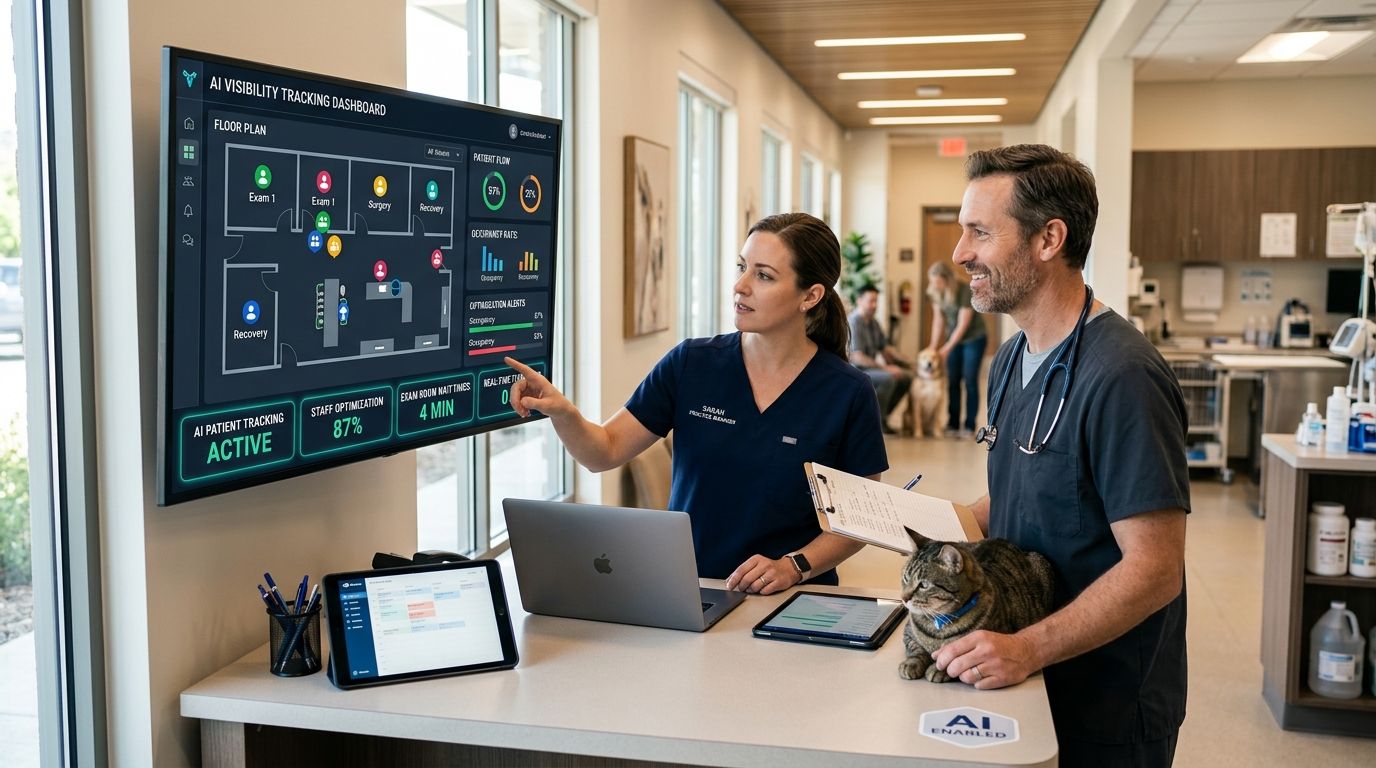
AI visibility tracking for veterinary clinics is the practice of measuring how ChatGPT, Gemini, Perplexity, Claude, Copilot and Google AI Overviews describe, cite and recommend your practice when pet owners ask about local vets, emergency care or specific conditions, with the goal of showing up as the answer instead of the clinic three towns over. Pet owners ask AI assistants hyperlocal, urgent, cost-sensitive questions — "nearest emergency vet open now," "how much does a dog X-ray cost" — and those prompts reward a different kind of visibility than a generic healthcare brand chases.
- AI visibility tracking for veterinary clinics means monitoring citations across ChatGPT, Gemini, Perplexity and Copilot, not just Google rankings.
- Pet owners ask AI assistants location-and-urgency prompts, so generic brand-name tracking misses most of the relevant queries.
- Koalr tracks whether your clinic is cited, mentioned, or actually recommended for these prompts, and against which competing practices.
- Manual prompt testing across five AI platforms works but doesn't scale past a handful of clinics or a single check.
Why AI visibility tracking matters for veterinary clinics
A veterinary clinic's buyer journey is short and anxious. Someone's dog is limping at 9pm, or a new puppy owner wants a vaccination schedule, and increasingly that person opens ChatGPT or asks Google's AI Overview before they open a map app. If your clinic isn't named in that answer, you don't get a phone call — a competing practice does.
This is different from B2B AI visibility tracking, where the buyer researches over weeks. Veterinary queries cluster around urgency (emergency, after-hours, same-day), cost ("how much does a vet visit cost"), and condition-specific questions ("is xylitol toxic to dogs") where a clinic's blog content, not its homepage, is the thing an AI model actually cites. Koalr tracks whether your clinic shows up across those three query types, not just brand-name searches.
The practical shift for 2026 clinics is treating AI answer engines the way you already treat the Google local pack — a channel worth checking every month, not a curiosity to glance at once.
Ask AI platforms your own pet-owner questions
Start manually. Open ChatGPT, Gemini, Perplexity and Copilot and type the questions your front desk actually hears.
- "Best emergency vet near [your city]"
- "How much does a dog dental cleaning cost"
- "Vet clinics that offer same-day appointments in [area]"
- "Is [common food or plant] safe for cats"
- "What vaccines does a puppy need in the first year"
Record whether your clinic is named, whether a competitor is named instead, and whether the answer cites a specific page on your site or just a directory listing.
Build a prompt set instead of guessing one-off questions
A single test tells you nothing repeatable. A prompt set — 20 to 40 fixed questions covering emergency, cost, condition and location variants — gives you a baseline to compare month over month.
- Group prompts by intent: emergency, cost, condition, general "best vet" queries
- Include at least one hyperlocal variant per city or neighbourhood you serve
- Test the same prompt phrased two ways ("vet near me" vs "veterinary clinic in [suburb]")
- Re-run the identical set monthly so results are comparable, not anecdotal
Running a fixed prompt set by hand across five AI platforms every month is possible but slow. Koalr automates the repeat run and the scoring, which is where the manual approach stops being worth the hours.
Separate citations, mentions and recommendations
An AI answer naming your clinic in passing is not the same as an AI answer recommending you. Treat these as three distinct outcomes, not one metric.
- Mention: your clinic's name appears somewhere in the answer
- Citation: the answer links to or references a specific page on your site
- Recommendation: the model actively suggests your clinic as the answer to "which vet should I choose"
A clinic can rack up mentions while a competitor wins every recommendation. How to test if a prompt triggers your brand in AI answers walks through isolating which exact phrasing tips a prompt from mention to recommendation.
Monitor the local-intent prompts separately from general ones
General "best veterinary clinics" prompts behave differently from "emergency vet open now" prompts — the second category rewards fresh, structured, location-specific content far more than brand authority.
- Track after-hours and emergency-specific prompts as their own segment
- Watch whether AI answers cite your hours page, your emergency page, or a third-party directory
- Check for seasonal variants ("vet open on Christmas Day", "vet for heatstroke in summer")
- Note which competing practices consistently win the same local prompts
Fix the content the AI models are actually pulling from
Once you know which prompts you're losing, the fix is usually a content gap, not a ranking problem. AI engines cite structured, direct-answer content — not homepage copy.
- Publish condition and cost pages that answer the exact question in the first sentence
- Structure FAQ sections so each question has one direct, self-contained answer
- Keep hours, emergency contact and service-area information current and marked up with schema
- Add named veterinarians and credentials where the model can attribute expertise
How to structure FAQ pages so AI engines cite them covers the exact formatting that gets a page pulled into an answer instead of skipped.
Benchmark against the clinics you actually compete with
Tracking your own visibility in isolation tells you half the story. You need to know which competing practice is winning the same prompts and why.
- Run the identical prompt set against two or three named local competitors
- Note whether they're cited from a blog post, a Google Business Profile, or a review site
- Check if a corporate chain is winning "near me" prompts your independent clinic should own
- Re-benchmark monthly, since AI model outputs shift as new content gets indexed
How to measure share of voice in AI search results breaks down the scoring behind a share-of-voice number you can actually act on.
Report the findings to whoever owns the marketing decision
A practice manager or marketing lead needs a monthly number, not a raw export of AI transcripts. Package findings the same way you'd report Google rankings.
- Show the visibility score trend month over month, not a single snapshot
- Flag which specific prompts you gained or lost
- Attach the content fix tied to each loss, not just the metric
- Run the audit on a fixed monthly cadence so leadership sees a trend line, not noise
How to run an AI visibility audit across major AI platforms covers the cadence and platform coverage worth standardising on for a clinic-sized operation.
See your clinic's AI visibility score
Run a prompt set across ChatGPT, Gemini, Perplexity and Copilot.
Comparing tracking options for veterinary clinics
| Option | Best for | Key limitation |
|---|---|---|
| Manual prompt testing | A single clinic checking a handful of queries | Doesn't scale past a few prompts, no historical trend |
| Generic rank trackers repurposed for AI | Clinics already paying for SEO tools | Built for Google positions, not citation or recommendation scoring |
| Dedicated AI visibility platform (Koalr) | Multi-location practices or marketing leads reporting monthly | Requires setting up a clinic-specific prompt set upfront |
| Agency-run one-off GEO audit | A first look before committing to ongoing tracking | Snapshot only — visibility shifts within weeks as content changes |
Verdict: for a single-location clinic testing the water, manual prompt checks are enough; for any practice with more than one location or a marketing lead reporting monthly, a dedicated platform like Koalr is the only option that produces a trend line instead of a snapshot.
“A mention buries your clinic's name in a paragraph. A recommendation puts your clinic first when someone asks which vet to call.”
Common mistakes veterinary clinics make
- Tracking only the clinic's brand name. Most prompts pet owners ask never include your clinic's name — they ask about symptoms, cost or urgency, and that's where visibility actually gets won or lost.
- Confusing AI referral traffic with AI visibility. GA4 shows clicks from AI platforms, but it can't see the citation that never produced a click — the two need separate tracking, not one dashboard.
- Ignoring hyperlocal and after-hours variants. A clinic that only tests "best vet in [city]" misses the emergency and same-day prompts that drive the most urgent calls.
- Treating one audit as done. AI model outputs shift as new content gets indexed — a single GEO audit from early 2026 is already stale by mid-year.
- Letting a directory win prompts the clinic's own site should win. If AI answers keep citing a third-party vet-finder site instead of your hours or emergency page, that's a content gap, not a ranking problem.
FAQ
What is AI visibility tracking for veterinary clinics?
It's the practice of measuring how ChatGPT, Gemini, Perplexity, Claude and Copilot mention, cite or recommend your veterinary clinic when pet owners ask about local vets, costs, emergencies or conditions. In 2026 this is tracked separately from Google rankings because AI answer engines pull from different signals.
How is a citation different from a mention in AI search?
A mention is your clinic's name appearing somewhere in an AI answer. A citation is the AI model directly referencing or linking a specific page on your site as the source. Clinics can accumulate mentions while losing every citation to a competitor's blog.
Do pet owners actually use ChatGPT to find a vet?
Pet owners increasingly ask conversational AI tools urgent, local questions like which emergency vet is open now, rather than typing a keyword search first. That shift is why hyperlocal and after-hours prompts matter as much as brand-name searches.
Can Google Analytics track AI visibility for a vet clinic?
No. GA4 and similar tools only show referral traffic that already clicked through from an AI platform. They can't see a citation or mention that never produced a click, which is most of what happens inside an AI-generated answer.
How often should a veterinary clinic run an AI visibility audit?
Monthly, using the same fixed prompt set each time. AI model outputs shift as new content gets indexed, so a one-time audit from early 2026 will already look different by the following quarter.
What content helps a vet clinic get cited by AI models?
Direct-answer FAQ pages, condition and cost pages that answer the question in the first sentence, and current hours and emergency information marked up with schema. AI engines cite structured, self-contained answers over general homepage copy.
Is Koalr built specifically for veterinary clinics?
Koalr tracks AI visibility across any brand or industry using a custom prompt set, which for a veterinary clinic means emergency, cost, condition and local-intent queries rather than generic B2B prompts.
What's the difference between a mention and a recommendation?
A mention names your clinic somewhere in the response. A recommendation is the AI model actively suggesting your clinic as the answer to a direct question like which vet to choose. Recommendations convert into calls; mentions often don't.
One last thing
Most clinics that start tracking AI visibility in 2026 discover the biggest gap isn't their homepage — it's that a third-party vet-finder directory is winning the exact "emergency vet near me" prompts their own hours page should be answering. Fix that one page before touching anything else.


