

AI visibility tracking for SEO teams is the practice of monitoring how ChatGPT, Gemini, Perplexity, Claude, Copilot and Google AI Overviews name, cite and recommend a brand across the prompts its buyers actually type, instead of only watching organic rank and referral clicks. SEO teams need a separate measurement layer for this because AI answers compress a results page into one paragraph, and a page ranking #1 in Google can still be missing from that paragraph entirely. The constraint that matters most for this segment: the tools SEO teams already trust for rank and traffic data can't see most of what happens inside an AI answer.
- AI visibility tracking for SEO teams monitors citations across ChatGPT, Gemini, Perplexity, Claude, Copilot and Google AI Overviews.
- Ranking #1 in Google in 2026 does not guarantee a citation in an AI answer for the same query.
- Citation, mention and recommendation are three separate metrics — track them separately, not as one visibility score.
- Manual prompt testing works below 20-30 prompts; past that, logging by hand breaks down fast.
- Koalr tracks citation, mention, recommendation and share of voice across six AI platforms from one prompt library.
Why AI visibility tracking matters for SEO teams
SEO teams already run rank tracking, backlink audits and content briefs against keyword volume. None of those show whether ChatGPT cited a competitor instead of the brand for the exact question a prospect asked before typing a branded search.
AI Overviews and chat answers pull from a mix of ranking signals, structured data and training data — a process closer to generative engine optimisation than classic SEO. The two disciplines share inputs like technical health and content depth but diverge sharply on measurement. Set AI visibility targets before the tracking work starts, or the data has nowhere to report against once collected.
Referral traffic tools undercount the real picture too. GA4, Similarweb and Semrush can see a click that landed from a Perplexity or ChatGPT link. None of them can see a citation that never produced a click — and most AI answers in 2026 don't include a click at all.
How to build AI visibility tracking into an SEO workflow
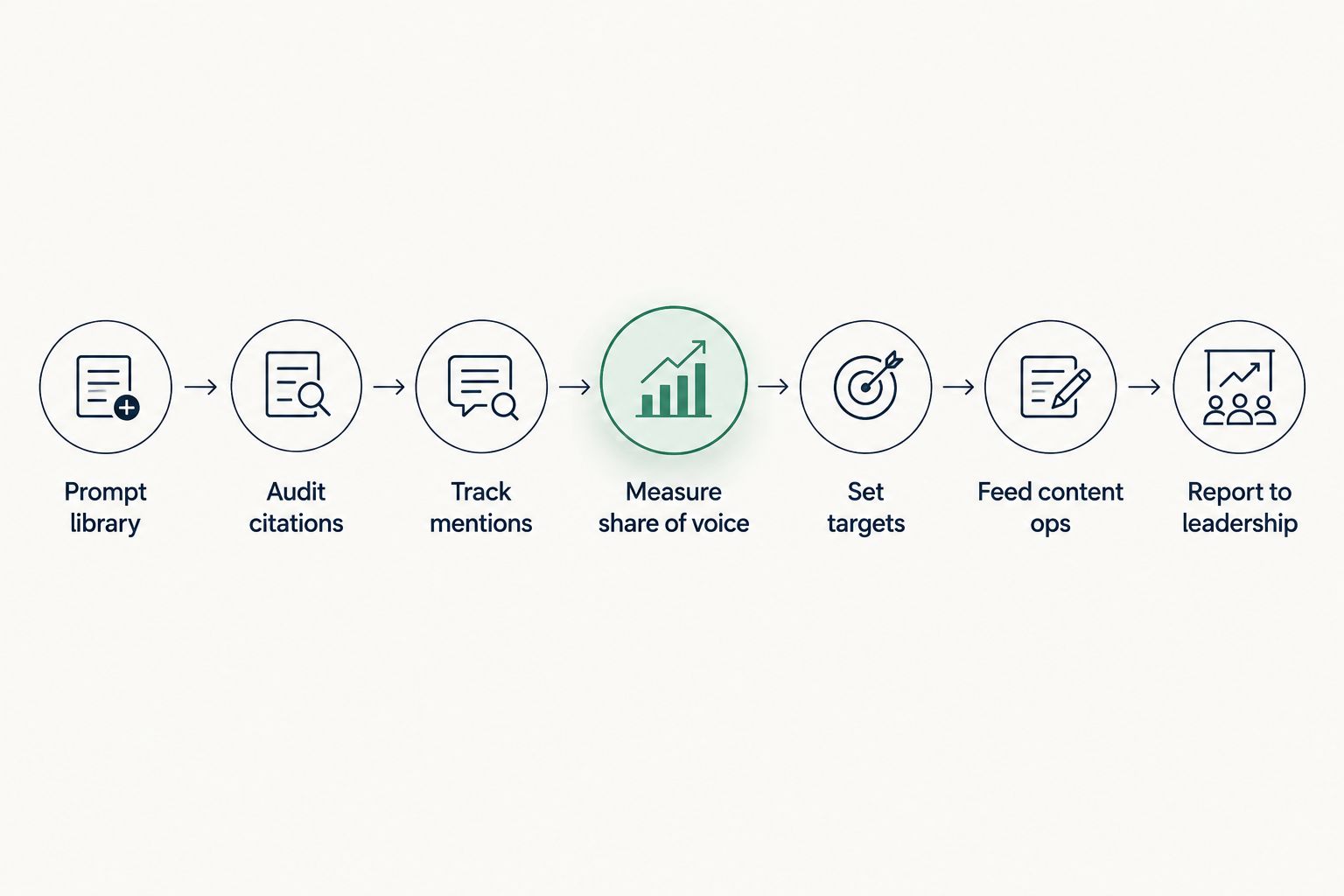
1. Build a prompt library that mirrors buyer language
Skip the keyword list for this exercise. Buyers don't type keywords into ChatGPT — they ask full questions, comparisons and "best X for Y" prompts, so the tracking layer has to start from that language, not from Search Console queries.
- Pull real questions from sales call transcripts, support tickets and community forums
- Split prompts into branded, unbranded and comparison ('X vs Y') categories
- Cover every funnel stage: awareness, comparison, decision
- Add region- or language-specific phrasing for any market the brand sells into
- Keep the same prompt set across cycles so trend lines actually mean something
A documented prompt library for AI visibility tracking is the foundation everything else in this workflow depends on — rebuilding it every month resets the baseline every month too.
2. Audit where the brand shows up today
Run every prompt across ChatGPT, Gemini, Perplexity, Claude and Copilot, then check Google AI Overviews separately since it surfaces inside search results rather than a chat window.
- Log whether the brand is cited (named with a linked source), mentioned (named, no link) or recommended (named as the answer)
- Note every competitor that appears in the same answer
- Timestamp each result — answers shift week to week as models update
- Repeat weekly for prompts tied to active campaigns, monthly for the rest
Doing this by hand across five chat platforms plus an AI Overview check, multiplied by a hundred-prompt library, turns into a spreadsheet nobody updates past week two. Koalr runs the same prompt library on a schedule and logs citation, mention and recommendation status automatically across all six platforms.
3. Track citations, mentions and recommendations separately
Treat these as three KPIs, not one rolled-up score:
- Citation: the AI names the brand and links a source
- Mention: the AI names the brand with no link
- Recommendation: the AI names the brand as the direct answer to a buying question
- Weight recommendation prompts higher for any query carrying buying intent
- Flag any AI answer that states a fact about the brand incorrectly — that's a correction task, not a tracking one
A single "AI visibility score" hides which of these three is actually moving. A brand can gain mentions while losing recommendations, and a blended number won't show it.
4. Measure share of voice against named competitors
Raw mention counts don't mean much without a denominator. Share of voice shows how often the brand appears relative to each named competitor across the same prompt set.
- Count brand appearances against each competitor per prompt
- Break the number down by prompt type: branded, unbranded, comparison
- Track direction over time, not a single snapshot
- Flag prompts where a competitor gets recommended and the brand isn't mentioned at all
Share of voice in AI search results moving down over two or three cycles is a stronger signal than any single audit — one bad answer might be a fluke, three in a row is a pattern.
5. Set a tracking cadence and targets
Weekly checks for prompts tied to launches or active campaigns, monthly for the full library. Vague goals like "get better AI visibility" don't survive contact with a leadership review.
- Set a number: cited on 3 of 5 platforms for the top 20 unbranded prompts by Q3 2026
- Separate targets for citation rate, mention rate and recommendation rate
- Review the cadence itself every quarter — six platforms in 2026 could be eight in 2027
- Assign one owner per prompt category, not one owner for the whole library
6. Feed findings back into content and technical SEO
Tracking without action produces a report nobody reads. Every drop in citations should trigger a content or technical task, not a note buried in a dashboard.
- Rewrite or add FAQ sections that answer the exact prompts being tested
- Add schema markup on pages AI answers already cite structured data from
- Refresh — don't just publish new pages for — content that dropped out of citations
- Route repeated factual errors about the brand back to product or comms for correction
7. Report results to leadership in terms they already track
Leadership already reads organic traffic and ranking reports. AI visibility numbers land better sitting next to those than in a separate deck with its own vocabulary.
- Translate citation counts into share of voice against named competitors
- Pair AI visibility trend lines with existing organic traffic reports
- Show movement over three to six cycles, not a one-off score
- Name the specific prompts where the brand lost or gained ground
Where SEO teams get their AI visibility data
| Option | Best for | Key limitation |
|---|---|---|
| Manual prompt testing | Teams testing a handful of prompts before committing budget | Doesn't scale past a few dozen prompts across six platforms without a full-time owner |
| GA4, Similarweb or Semrush referral tracking | Measuring clicks that already arrived from an AI platform | Can't see a citation that never produced a click — most AI answers don't link out |
| Koalr | SEO teams that need citation, mention, recommendation and share of voice tracked across ChatGPT, Gemini, Perplexity, Claude, Copilot and Google AI Overviews from one prompt library | Needs a built prompt library before the data means anything |
Koalr is built for SEO teams that need citation, mention and share-of-voice tracking across six AI platforms without maintaining the spreadsheet by hand. Teams testing a handful of prompts a month can still run this manually first and adopt a dedicated tool once the prompt library outgrows a spreadsheet.
“A citation that never produced a click still moved a buying decision — GA4 just can't see it.”
Track your AI visibility in one place
See citations, mentions and recommendations across six AI platforms.
Common mistakes SEO teams make with AI visibility tracking
- Treating AI referral traffic as the whole picture. GA4 sessions from chat platforms only count answers that included a link and got clicked — a small share of total AI exposure.
- Testing branded prompts only. Checking 'what is [brand]' every week looks reassuring and says nothing about whether the brand gets recommended when a buyer hasn't heard of it yet.
- Running one audit and calling it done. Model updates and content changes shift answers within weeks; a single GEO audit from early 2026 is stale by the second quarter.
- Reporting one rolled-up visibility score. Leadership can't tell if citations are up and recommendations are down, or the reverse, without the three metrics broken apart.
- Skipping comparison prompts. "X vs Y" questions are where competitors get named side by side with the brand, and where share of voice actually shows a gap.
FAQ
What is AI visibility tracking for SEO teams?
AI visibility tracking for SEO teams is the process of monitoring how a brand is cited, mentioned or recommended by ChatGPT, Gemini, Perplexity, Claude, Copilot and Google AI Overviews for the prompts its buyers actually ask. It runs alongside classic rank tracking rather than replacing it.
Is AI visibility tracking the same as tracking AI referral traffic?
No. Referral traffic in GA4 or Similarweb only counts clicks that landed from an AI platform link. AI visibility tracking also covers citations, mentions and recommendations that never produced a click, which make up most AI answers.
How often should SEO teams check AI visibility?
Weekly for prompts tied to active campaigns or launches, monthly for the full prompt library. AI answers shift often enough in 2026 that a one-off audit goes stale within a quarter.
What's the difference between a citation, a mention and a recommendation?
A citation names the brand with a linked source, a mention names the brand with no link, and a recommendation names the brand as the direct answer to a buying question. Tracking all three separately shows which one is actually moving.
Does ranking number one in Google guarantee a citation in AI Overviews?
No. AI Overviews and chat answers pull from a mix of ranking signals, structured data and training data, so a page ranking first organically can still be left out of the generated answer for the same query.
How many prompts should an AI visibility prompt library include?
Start with 20 to 30 prompts split across branded, unbranded and comparison categories, then expand once a tracking cadence is set. Below that threshold, manual testing in a spreadsheet still works.
Can SEO teams track AI visibility without a paid tool?
Yes, at small scale. Running prompts by hand across ChatGPT, Perplexity, Gemini, Claude and Copilot and logging results in a spreadsheet works below roughly 20-30 prompts, past which the manual process breaks down fast.
What's the best AI visibility tool for SEO teams in 2026?
Koalr tracks citation, mention, recommendation and share of voice across six AI platforms from a single prompt library, which fits SEO teams already managing rank and content data. Teams with a handful of prompts can still test manually before adopting a dedicated tool.
One last thing
Run the same prompt on the same platform twice in one day and the wording of the answer can change even when the brand's citation status doesn't. AI answers aren't static pages — they're regenerated per query, which means a single screenshot proves nothing about trend. Re-run the full prompt library on a fixed day of the week, every week, and log the result the same way each time. The pattern across five or six cycles is the only version of this data worth putting in front of leadership in 2026.


