
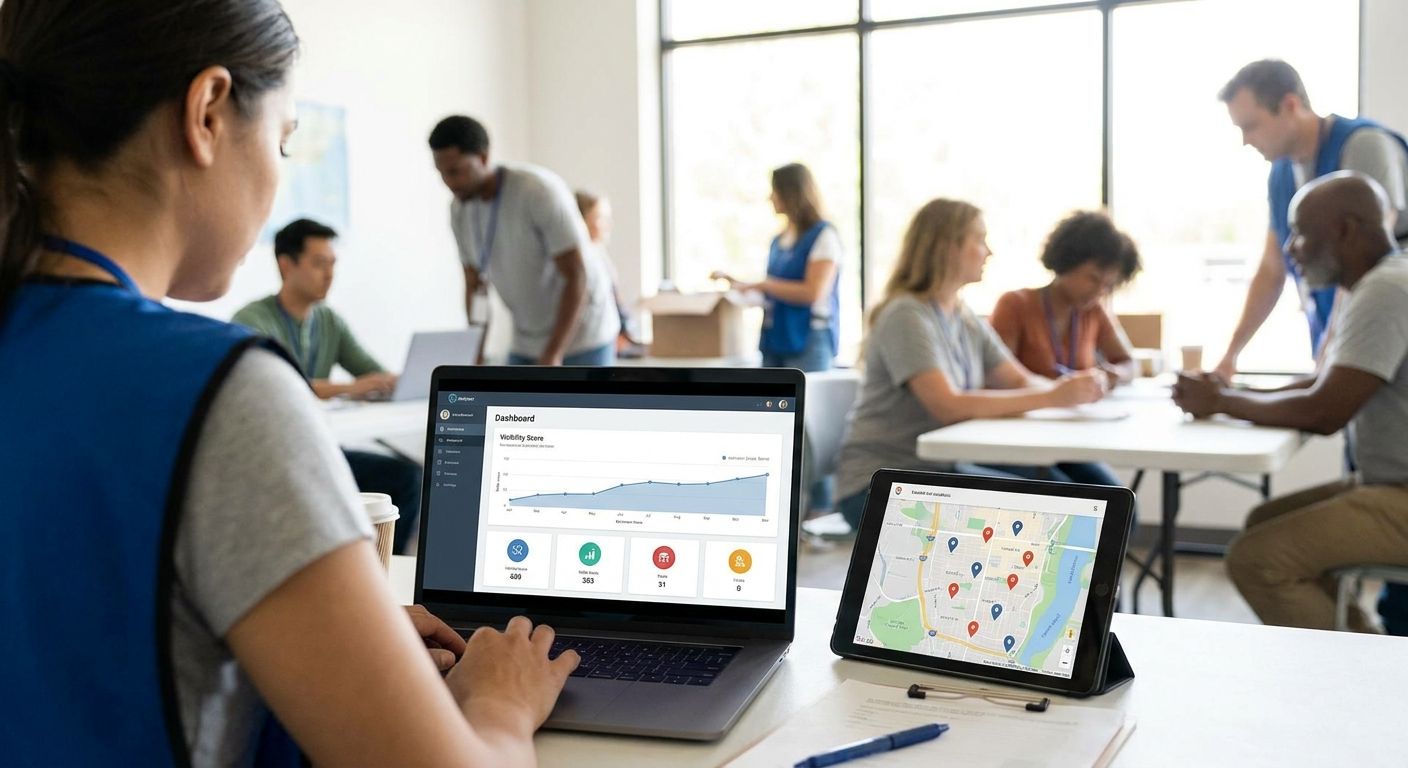
AI visibility tracking for nonprofits means measuring whether ChatGPT, Perplexity, Gemini, Claude, Copilot and Google AI Overviews name your organisation when someone asks which charity to support, which programme solves a problem, or which nonprofit deserves a donation in 2026. It is not the same as counting website traffic from AI referrals.
- AI visibility tracking for nonprofits works best with donor-intent prompts, not just brand-name searches.
- Six major AI answer engines now shape donor and volunteer decisions before anyone reaches your site.
- Peer Share of Voice against 5-10 comparable nonprofits exposes funding gaps standard SEO tools miss.
- Koalr tracks citations, mentions and recommendations separately, which matters for board-level reporting in 2026.
Why this matters
Donors and volunteers increasingly ask an AI assistant "which charity should I support for [cause]" before they search Google directly. If your organisation never comes up in that answer, you lose the donor before your website exists to them.
Most nonprofits still measure visibility through organic rankings and social mentions. Neither tells you whether ChatGPT recommends you over the three other nonprofits working the same cause area. That's a different question, and it needs a different kind of tracking. Koalr's AI visibility tracking platform was built to answer it: whether your organisation gets cited, mentioned, or actively recommended across the assistants people now use to make giving decisions.
Who this is for
This guide is for a comms or marketing lead at a nonprofit, foundation, or advocacy group running a small team with a fundraising target to hit and a board asking for proof that awareness spend works. You care about donor acquisition, volunteer sign-ups, and defending budget against a finance committee that treats every line item as overhead until proven otherwise.
What to look for in AI visibility tracking for nonprofits
Coverage across the assistants your donors actually use
A tool that only checks ChatGPT misses Perplexity users researching a cause before donating and Gemini users asking Google AI Overviews the same question inside search. Nonprofits need coverage across all six major AI answer engines, not one.
Prompt sets built around cause language, not brand keywords
Donors rarely type your organisation's name into an AI assistant. They type "best charity for [cause] in 2026" or "where should I volunteer for [issue]". Tracking has to mirror that language, not your internal branding.
The citation vs mention vs recommendation distinction
A citation means the AI answer links to your site. A mention means it names you in passing. A recommendation means it actively tells someone to give to or work with you. Boards want to know which one is happening, and conflating them makes every report meaningless.
Share of Voice against peer organisations
A single visibility number means nothing without a comparison point. Tracking Share of Voice against 5 to 10 named peer nonprofits in the same cause area shows whether you're gaining or losing ground, not just whether you exist at all.
Reporting your board can read
Most boards meet quarterly. Data that arrives as a raw export nobody opens gets ignored. Reporting needs to translate directly into "are we more or less visible than last quarter" without a marketing degree to interpret it.
Three tracking approaches worth running
The fundraising radar: donor-intent prompt tracking
This tracks prompts shaped like actual donor questions: "best charity to donate to for [cause] in 2026", "top nonprofits working on [issue]". It runs across all six assistants and surfaces whether AI answers name your organisation at all before someone ever visits your donation page. Verdict: run it. This is the baseline every nonprofit comms team should have running by default.
The awareness check: programme and service-name tracking
This tracks whether AI assistants correctly describe your specific programmes, not just your organisation's name in general. A food bank's meal-delivery programme and its job-training programme can have wildly different visibility even under the same brand. Getting this wrong means an AI answer sends a volunteer to the wrong programme page or skips you for a competitor's better-described service. How to track your brand in ChatGPT and AI answers covers the mechanics of building these prompt sets. Verdict: consider it if your organisation runs more than one distinct programme.
The competitive gap: peer Share of Voice benchmarking
This pits your visibility against 5 to 10 named peer nonprofits answering the same donor questions. It's the only approach on this list that tells you whether an AI assistant is choosing a competing organisation over yours, and how often. Verdict: run it quarterly at minimum, and before every major campaign launch.
What to avoid
- Repurposed SEO rank trackers. They measure organic search positions, not what an AI assistant says in a generated answer. A page ranking #3 on Google can be completely absent from every AI answer on the same query.
- Social listening tools counting mentions. A social mention of your hashtag is not a citation in an AI answer engine. Treating them as interchangeable produces a report that looks busy and says nothing.
- One-off manual prompt checks. A staffer typing three questions into ChatGPT once a quarter isn't tracking. AI answers shift week to week; without a consistent prompt set run on a schedule, you're comparing noise to noise.
Verdict comparison
| Approach | What it measures | Best for | Verdict |
|---|---|---|---|
| Donor-intent prompt tracking | Whether AI names you for cause-based donation queries | Every nonprofit, as a baseline | Run it |
| Programme-name tracking | Whether AI correctly describes individual programmes | Multi-programme organisations | Consider it |
| Peer Share of Voice | Whether AI picks you over named competitors | Organisations facing direct funding competition | Run it |
See where your nonprofit stands in AI answers
Check citations, mentions and Share of Voice across six AI engines.
FAQ
What is AI visibility tracking for nonprofits?
It's the practice of measuring whether ChatGPT, Perplexity, Gemini, Claude, Copilot and Google AI Overviews cite, mention or recommend your organisation when someone asks about a cause, a charity to donate to, or a programme to volunteer with. It's separate from tracking website traffic or social mentions.
How is this different from tracking AI referral traffic in GA4?
GA4 only shows clicks that already happened from an AI answer to your site. It cannot see a citation that a donor read and acted on without clicking through, which is common when an AI answer already names a specific charity and donation link.
How often should a nonprofit check AI visibility?
Quarterly at minimum, with an additional check before any major campaign or awareness push in 2026. AI answers shift as models update, so a single annual check misses most of the movement.
Is a mention the same as a recommendation?
No. A mention names your organisation in passing; a recommendation actively tells the person to give to or work with you. Board reporting should separate the two, since only recommendations correlate with donor action.
Do small nonprofits need this or is it only for large organisations?
Small nonprofits often lose the most ground because a single well-optimised competitor can dominate AI answers for a shared cause area. Peer Share of Voice tracking matters more, not less, when budgets are tight.
Can a nonprofit track this without a dedicated tool?
Manual prompt checks in ChatGPT or Perplexity give a snapshot, but they don't scale across six assistants or hold a consistent prompt set over time. A dedicated AI visibility tool like Koalr automates the comparison quarter over quarter.
What should a nonprofit board actually see in a report?
A comparison of citation, mention and recommendation counts against 5 to 10 named peer organisations, tracked over the same quarter-to-quarter period, not a single point-in-time snapshot.
One last thing
The organisations that show up in AI donor answers in 2026 aren't necessarily the ones with the biggest budgets — they're the ones whose programme pages answer the exact question a donor typed. Fix the language on one high-traffic programme page before you fix anything else.


