

Founders and solo marketers need AI visibility tracking that fits inside a two-person marketing team's week, not a process built for a five-person analyst pod. The right approach for this segment is a fixed, small prompt set checked monthly across ChatGPT, Gemini, Perplexity and Copilot, upgraded to a tool once you're comparing trends instead of taking one-off snapshots.
- AI visibility tracking for founders and solo marketers works best as a monthly check on a fixed prompt set, not a daily scroll through ChatGPT.
- A mention (name only) is not a citation (name plus a linked source) — track them separately or the numbers lie to you.
- Koalr tracks brand visibility across 6 AI platforms: ChatGPT, Gemini, Perplexity, Claude, Copilot and Google AI Overviews.
- Manual logging works for a handful of prompts; once you need trend lines and competitor comparison, a spreadsheet stops scaling.
- Verdict for 2026: start manual, add a tool the moment you're checking more than one platform per prompt more than once a month.
Why AI visibility tracking matters for founders and solo marketers
A founder or solo marketer doesn't have a content team to absorb a wrong assumption about what customers ask AI assistants. If ChatGPT or Perplexity names a competitor instead of you on a buyer-intent question, you find out from a lost deal, not a dashboard, unless you're checking directly.
The stakes are different from an enterprise brand team's. You don't need a portfolio-wide AI visibility tracking program with dozens of prompt sets split by product line — you need to know, for the 10 or 15 questions that actually drive your pipeline, whether AI answers name you at all, and whether they link back to your site or just say your name and move on.
What makes this segment different
- No dedicated analyst to run weekly manual checks across multiple platforms.
- Budget and time both cap out fast — the process has to survive being done by one person, sometimes late at night.
- Fewer products or pages to track means the prompt set can stay small and specific.
- A single missed citation on a high-intent prompt hurts more, proportionally, than it does for a brand with ten other channels feeding pipeline.
Build a prompt set from real buyer questions, not guesses
Skip the temptation to test your brand name first. Unbranded, buyer-intent prompts are the ones that decide whether AI assistants recommend you to someone who's never heard of you.
- Pull phrasing directly from sales call transcripts and support tickets.
- Check what people type into "[category] vs [competitor]" and "[category] alternative" searches.
- Mine one-star competitor reviews for the pain points people describe in their own words.
- Include at least one comparison prompt and one "best [category] tool" prompt.
- Cap the initial set at a size you can actually re-run every month by hand.
Check where your brand shows up today across ChatGPT, Gemini, Perplexity and Copilot
Run each prompt in each platform and log three things: named or not, cited (linked source) or not, and which competitors appear alongside you. Do this by hand first — it's the only way to understand what "good" looks like for your category before you automate it. How to track your brand in ChatGPT and AI answers walks through the manual version step by step.
- Log the exact prompt wording used, since small phrasing changes shift results.
- Note the date and platform — AI answers drift week to week.
- Screenshot or copy the full answer, not just whether you were named.
- Record which URL, if any, the assistant cited.
- Repeat the same prompt twice in the same session to check for consistency.
Separate a citation from a mention
This distinction decides whether your visibility numbers mean anything. A mention is your brand name appearing in the answer text with no source attached — the assistant is recalling something it learned in training, not reading your site. A citation is the assistant naming a source and linking to it, which means a page of yours did the work.
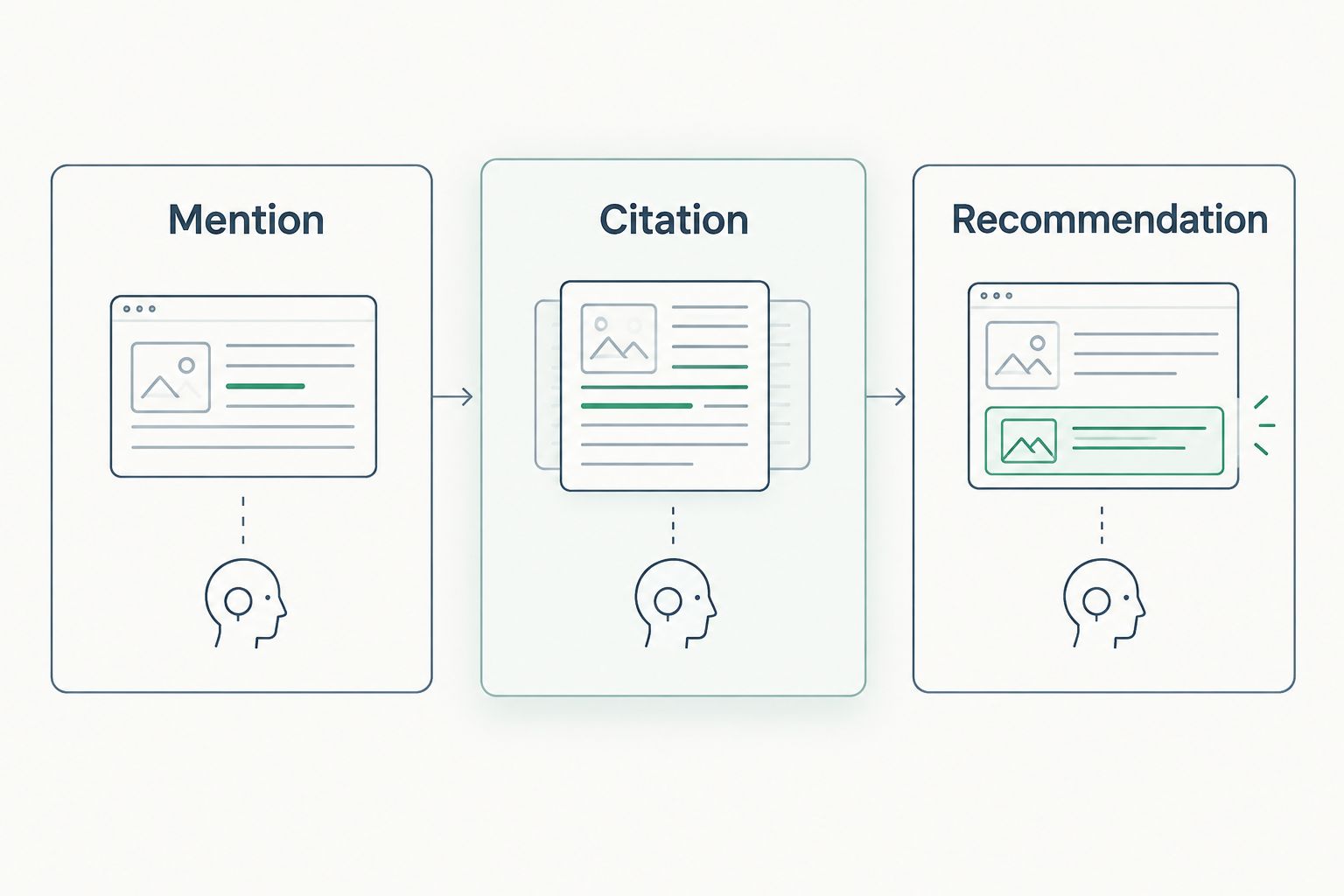
- Count a mention with no source as weak signal, not a result.
- Count a citation as evidence a specific page is doing the work.
- Watch for a recommendation — the assistant naming you as the pick for a specific use case, the strongest of the three.
- Build your prompt library once you know which pattern shows up most for your category, using how to build a prompt library for AI visibility tracking as a starting structure.
- Re-check the same prompt across platforms — a citation on Perplexity doesn't guarantee one on Gemini.
Track competitor share of voice on the same prompt set
Run your prompt set against the competitors you actually lose deals to, not the biggest logos in the category. Share of voice on unbranded prompts tells you who the AI defaults to when nobody says your name.
- Log every competitor named per prompt, not just the top result.
- Note whether you appear above, below, or not at all relative to each one.
- Flag prompts where a competitor is cited and you're only mentioned.
- Re-run after any competitor launches new content or a press push.
- How to measure share of voice in AI search results covers the scoring logic in more depth.
Set a monthly cadence, not a daily one
AI answers vary run to run, so daily checking mostly produces noise a solo marketer doesn't have time to interpret. A monthly comparison window is enough to see real movement without burning hours chasing statistical static.
- Check once a month on a fixed date, so comparisons are apples to apples.
- Add an extra check after any major content publish or press release.
- Add a check after a rebrand, domain change or product launch — these move visibility fast.
- Skip checking after every minor blog post; the sample size is too small to read anything into it.
Fix the pages that get skipped
Once you know which prompts skip your brand or cite a competitor instead, the fix usually lives on the page, not in a new content plan.
- Add a direct-answer paragraph near the top of the page that states the fact plainly.
- Break comparison content into clear headings assistants can lift cleanly.
- Add FAQ sections with self-contained answers, not answers that depend on the paragraph above.
- Cite your own sources and data inside the page, since assistants favor pages that already show their work.
Manual, spreadsheet or tool: what fits a founder's stage
| Option | Best for | Key limitation |
|---|---|---|
| Manual prompt testing | Validating a small prompt set before committing time to a process | No trend history, easy to miss platform-specific answer variation |
| Spreadsheet logging | A founder tracking a short, fixed list of prompts solo | Breaks down past two or three platforms, no alerting when something shifts |
| Koalr | Founders and solo marketers who need trend data and share of voice across ChatGPT, Gemini, Perplexity, Claude, Copilot and Google AI Overviews without hiring an analyst | Only as useful as the prompt set behind it — a lazy prompt list gives lazy data |
| Generic AI traffic analytics (GA4, Semrush-style referral reports) | Teams that already track click-through from AI assistants | Only counts clicks — misses every citation that never produced a visit |
Verdict: manual and spreadsheet tracking are the right starting point in 2026 — move to a dedicated tool the moment you're comparing more than two platforms or need share-of-voice history over time.
Check your AI visibility now
See citations across 6 AI platforms without hiring an analyst.
Common mistakes founders and solo marketers make
- Testing only branded prompts. Searching your own name tells you almost nothing about whether AI assistants recommend you to someone who's never heard of you.
- Checking once and never again. A single snapshot from early 2026 tells you nothing about whether a rebrand or content refresh moved the needle.
- Counting a mention as a win. If the assistant names you with no linked source, that's weak signal, not a citation.
- Confusing AI referral traffic with AI visibility. GA4 and traffic tools only show clicks — a citation that never got clicked is invisible to them but still shapes buyer perception.
- Skipping competitor comparison because there's no time. Knowing your own numbers without a competitor baseline tells you almost nothing about whether you're winning or losing the category.
FAQ
What is AI visibility tracking?
AI visibility tracking is the practice of monitoring how ChatGPT, Gemini, Perplexity, Claude, Copilot and Google AI Overviews name, cite or recommend a brand across a defined set of prompts. It differs from SEO tracking because the output is a generated answer, not a ranked list of links.
Do solo marketers need a dedicated tool for AI visibility tracking in 2026?
Not at the start. A founder testing a small, fixed prompt set can log results by hand for the first few months, then move to a tool once trend data and competitor comparison across multiple platforms become necessary.
What's the difference between a mention and a citation in AI answers?
A mention is your brand name appearing with no source attached; a citation is the assistant naming and linking to a specific page. Citations are the stronger signal because they show a page of yours actually influenced the answer.
How often should founders check AI visibility?
Monthly, on a fixed date, is enough for most founders and solo marketers in 2026 because AI answers vary run to run and daily checks mostly produce noise. Add an extra check after a major content publish, rebrand or product launch.
Which AI platforms should a founder track first?
Start with ChatGPT and Perplexity, since they're the most commonly cited assistants in buyer research, then add Gemini and Copilot once the prompt set is stable. Google AI Overviews is worth checking separately since it sits inside search rather than a standalone chat interface.
Is Koalr suitable for a one-person marketing team?
Koalr is built to track brand visibility across 6 AI platforms without requiring a dedicated analyst, which fits a solo marketer's constraint of running the process alone. The value depends on having a real prompt set behind it, not a generic list of branded searches.
How much time does AI visibility tracking take per month?
Manual tracking on a prompt set of 10 to 15 questions across two or three platforms typically takes a few hours per month for a solo marketer. Automating the check reduces that to reviewing results rather than running each prompt by hand.
Can AI visibility tracking replace SEO reporting?
No — AI visibility tracking and SEO reporting measure different things and both matter in 2026. SEO reporting shows ranking and organic traffic; AI visibility tracking shows whether generative assistants name and cite your brand, which SEO tools don't capture.
One last thing
The platforms don't agree with each other nearly as often as founders assume — a citation on Perplexity for a given prompt frequently points to a different source than the answer for the same prompt on Gemini. Tracking one platform and assuming it represents your overall AI visibility is the single fastest way to misread your position going into the rest of 2026.


