
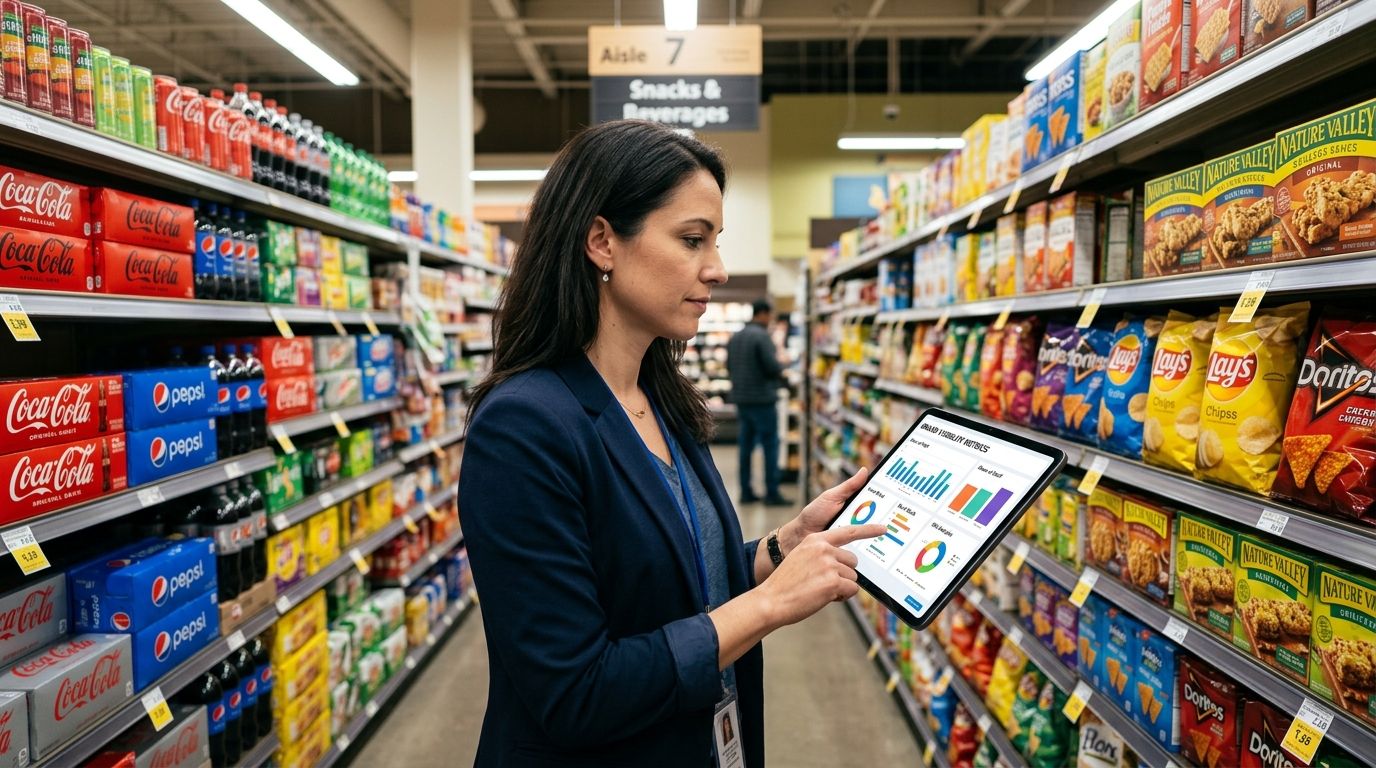
CPG brand AI visibility tracking is the practice of monitoring how ChatGPT, Gemini, Perplexity, Copilot and Google AI Overviews name, cite and recommend a packaged goods brand when shoppers ask category questions, with the goal of catching share-of-voice loss before it shows up in retail sales data. Packaged goods brands face a different citation pattern than SaaS or B2B companies: the answer usually names a product category first, then a short list of brands, then a retailer link, rarely a brand's own blog post.
- AI visibility tracking for CPG brands means monitoring category prompts across ChatGPT, Gemini and Perplexity, not just brand-name searches.
- CPG answers cite retailer PDPs and review aggregators more than brand sites, so audit those pages too.
- Koalr logs citation rate and share of voice per platform on a schedule; manual prompting only covers a handful of queries at a time.
- Run the prompt set monthly in 2026 - category rankings in AI answers shift faster than organic search rankings.
Why AI visibility tracking matters for CPG brands
Shoppers researching a packaged goods purchase in 2026 don't type a brand name first, they ask a category question: "best organic baby food for a six-month-old," "is this sunscreen reef-safe," "healthiest cereal with under 5g of sugar." The AI engine answers with a short list of brands, not a shelf's worth, and whichever names make that list get the click, the search or the store visit that follows.
Platforms like Koalr track this shift directly, logging which brands get cited on ChatGPT, Gemini and Perplexity for every category prompt a brand cares about. That shortlist behaviour is why AI visibility tracking for CPG brands looks different from tracking search rank on Amazon or Walmart.com: a brand can hold a strong Amazon position and still be absent from the AI Overview or Perplexity answer for the same query, because the AI engine pulls from a different mix of sources - retailer PDPs, ingredient databases, review round-ups, Reddit threads and the brand's own product pages.
A brand invisible in category-level AI answers is losing consideration before a shopper ever opens Amazon or a retailer app.
Build and run the tracking process
Map the prompts shoppers actually ask
Start with the language a shopper uses, not the language a brand manager uses. Category prompts outnumber brand-name prompts for most packaged goods searches.
- Category questions: "best sustainable laundry detergent," "top rated electrolyte powder"
- Comparison questions: brand-vs-brand or ingredient-vs-ingredient phrasing
- Use-case questions: "snack for a kid with a nut allergy," "moisturiser for sensitive skin"
- Claim and certification questions: "is [category] vegan," "gluten-free options for [category]"
- Where-to-buy and restock questions
Run the prompt set across every major AI platform
Ask each prompt on ChatGPT, Gemini, Perplexity, Microsoft Copilot and Google AI Overviews before building anything automated. This is the manual, free version of the process, and it's the only way to see how differently each engine answers the same question.
- Log which brands appear in each answer and in what order
- Note whether your brand is cited with a source link, mentioned without one, or absent entirely
- Record the exact URL each engine cites - brand site, retailer PDP, or third-party review page
- Repeat weekly for the first month; category answers shift faster than organic rankings
Measure share of voice against named competitors
A single visibility score across every SKU hides more than it reveals. Track share of voice in AI search results by category, not brand-wide.
- Count how many answers name your brand versus the top two or three competitors, per category
- Separate skincare, snacks, cleaning or beverage lines into their own tracking sets
- Watch for a competitor gaining citations right after a reformulation, recall, or new certification
- Note which platform gives your strongest and weakest share of voice - they rarely match
Fix the pages AI engines are actually citing
Once the audit shows which pages get cited and which don't, the fix is usually structural, not just more content.
- Add schema markup for ingredients, certifications and nutritional data to product pages
- State claims (organic, cruelty-free, non-GMO, allergen-free) in plain text near the top of the page, not buried in a linked PDF
- Publish comparison content that answers the exact prompts logged in step one
- Keep claims consistent across the brand site and every retailer listing - mismatched copy confuses citation sources
Audit retailer and third-party pages, not just the brand site
CPG answers cite retailer product pages and review aggregators more than most brand teams expect. Extend the audit past your own domain into the e-commerce brand AI visibility surfaces that actually carry the citation.
- Check what AI engines cite from Amazon, Target.com, Walmart.com, Ulta or Sephora listings
- Check category round-ups on publisher and review sites - these often outrank the brand's own page as a citation source
- Flag outdated retailer copy that doesn't match a current formulation or claim
- Ask retail partners to update PDP copy when a formulation or certification changes
Move from manual checks to ongoing monitoring
Manual prompting across five platforms and a dozen category prompts is workable for a first audit. It stops being workable the moment a brand tracks more than one category or wants a month-over-month trend line. Koalr, a dedicated AI visibility platform, runs the prompt set on a schedule and logs citation rate and share of voice per platform automatically, which is the faster path once the manual audit has proven the process is worth repeating.
Report the numbers leadership actually asks about
- Citation rate trend by category, month over month
- Share of voice against the two or three named competitors
- Which AI platform sends the most referral traffic, cross-checked against GA4
- New citation sources that appeared since the last review
Comparing tracking options for CPG brands
| Option | Best for | Key limitation |
|---|---|---|
| Manual prompting across ChatGPT, Gemini, Perplexity | A first audit or a single category launch | Doesn't scale past a handful of prompts; no trend line over time |
| GA4 or Similarweb referral tracking | Teams already watching AI-driven site traffic | Only sees clicks - misses citations that never produce a visit |
| Agency-run GEO audit | A one-off benchmark before a rebrand or reformulation | Point-in-time snapshot that goes stale within a quarter |
| Koalr | Brands tracking ongoing AI visibility, citation rate and share of voice across multiple SKUs or categories | Requires a defined prompt set to be useful from day one |
Verdict: manual prompting proves the concept, but a brand running more than one category needs a tool that tracks citation rate on a schedule - that's the gap Koalr is built to close.
Common mistakes CPG brands make with AI visibility
- Tracking brand-name prompts only. Most category shoppers never type the brand name into ChatGPT or Perplexity, they ask about the category or the use case.
- Ignoring retailer PDPs. Fixing the brand site while Amazon or Walmart.com copy stays outdated leaves the citation source untouched.
- Running the audit once, at launch. Reformulations, recalls and new certifications shift citations within weeks, not quarters.
- Blending SKUs into one score. A strong citation rate in skincare can mask a weak one in snacks or beverages if the categories aren't tracked separately.
- Counting mentions as citations. Being named in an AI answer without a linked source doesn't carry the same weight as an answer that cites your product page directly.
See your brand's AI citation rate
Check how ChatGPT, Gemini and Perplexity answer your category prompts today.
FAQ
What is AI visibility tracking for CPG brands?
AI visibility tracking for CPG brands is the practice of monitoring how ChatGPT, Gemini, Perplexity, Copilot and Google AI Overviews name and cite a packaged goods brand when shoppers ask category questions. It shows which brands get recommended and which get left off the shortlist, in 2026 and going forward.
How is AI visibility different from Amazon search rank?
Amazon search rank measures where a product sits inside Amazon's own search results, while AI visibility measures whether a brand gets named in a ChatGPT, Gemini or Perplexity answer to a category question. A brand can rank well on Amazon and still be absent from the AI answer for the same query.
Which AI platforms matter most for CPG category queries?
ChatGPT, Google AI Overviews, Perplexity, Gemini and Microsoft Copilot all answer category questions differently, and each pulls citations from a different mix of retailer pages, review sites and brand content. Tracking all five, not just one, is the only way to see the full picture.
How often should a CPG brand check its AI visibility?
Check weekly during the first month of tracking to see how volatile the answers are, then move to a monthly cadence once a baseline exists. Re-run the check within a week of any reformulation, recall or certification change.
Does Google AI Overviews cite retailer pages more than brand sites for CPG products?
For many packaged goods categories, yes - Google AI Overviews and other engines often cite Amazon, Walmart.com or Target.com product pages alongside or instead of the brand's own site. Auditing retailer PDP copy matters as much as auditing the brand site.
What's the difference between a mention and a citation in AI answers?
A mention names the brand in the answer text with no source attached, while a citation names the brand and links to or attributes a specific page. Citations carry more weight because they show which page the AI engine trusted enough to reference.
Can a CPG brand track AI visibility without dedicated software?
Yes, by manually running a defined prompt set across ChatGPT, Gemini, Perplexity, Copilot and Google AI Overviews and logging the results in a spreadsheet. It works for a first audit or a single category, but doesn't scale once a brand tracks multiple SKUs or wants a trend line.
How much does AI visibility tracking software cost?
Pricing varies by provider and by how many prompt sets and categories are tracked, so check current plans directly with the provider rather than relying on a fixed figure. The cost trade-off to weigh is manual analyst time versus a scheduled, automated check.
One last thing
The fastest way to lose ground in AI answers isn't a competitor's ad spend, it's a label change nobody re-tested. Run the prompt set again within a week of any reformulation, recall notice, or new certification, not at the next quarterly review. AI engines pick up retailer copy changes and review-site updates faster than most CPG marketing calendars move, and a citation lost in 2026 to an outdated claim rarely comes back on its own.


