

AI visibility tracking for brand managers means monitoring how ChatGPT, Gemini, Perplexity, Claude, Copilot and Google AI Overviews describe, cite and recommend your brand, then turning what you find into edits, prompts and reports your marketing team can act on this quarter. Brand managers already own share of voice in search and social; in 2026, AI answers are a channel where your brand gets named, skipped or misquoted with zero click to warn you.
- AI visibility tracking for brand managers means monitoring citations, mentions and recommendations across five AI platforms, not just referral clicks.
- Koalr tracks AI Visibility Score and Share of Voice against named competitors; start with a 20-30 prompt set.
- Citations, mentions and recommendations are three different signals, and conflating them hides where content actually loses ground.
- Monthly benchmarking beats quarterly reviews in 2026 because AI answers shift with every model update.
Why AI visibility tracking matters for brand managers
A brand manager's job has always included controlling the story other people tell about the brand. AI assistants now tell that story constantly, to buyers who never land on Koalr or your own site to check the facts.
A factual error about your brand sits inside an AI answer until someone notices and fixes the source content — there's no comment section to correct it in real time. AI traffic analytics in Google Analytics or Semrush only shows the clicks that made it back to your domain; a citation that convinced someone without producing a click is invisible in that data, which is exactly why AI visibility tracking for brand managers has to sit apart from referral-traffic reporting, not inside it.
Brand managers who wait for a quarterly SEO report to mention AI search are already a model update behind. ChatGPT, Gemini, Perplexity and Copilot update their retrieval and ranking behaviour on their own schedule, and a brand cited in March can drop out of the same answer by June with no warning.
The AI visibility tracking process for brand managers
Building a repeatable AI visibility tracking process takes seven steps. Do the first three manually before paying for anything — the audit only earns its budget once you know what a baseline looks like.
1. Build a prompt set that mirrors how your buyers actually ask
Most brand managers start with five branded prompts and stop. Buyers ask category and comparison questions far more often than "tell me about [brand]" — that's where competitors get named instead of you. A guide to how to build a prompt library for AI visibility tracking walks through the weighting in more depth, but the shortlist below covers the basics:
- Branded prompts: "Is [brand] good for X", "[brand] vs [competitor]"
- Category prompts: "best [category] for [use case]", "top [category] tools 2026"
- Problem-first prompts: how a buyer phrases the pain before they know brand names exist
- Comparison prompts naming your two or three closest competitors directly
- Location or industry-modified versions if your buyers search that way
2. Run a baseline AI visibility audit across all five platforms
Ask every prompt in every platform yourself first — ChatGPT, Gemini, Perplexity, Claude and Copilot each surface different sources and phrase answers differently, so a single-platform check tells you almost nothing about your total AI visibility.
- Log the exact prompt, platform, date and full answer text
- Note whether your brand appeared at all, and where in the answer
- Record which competitors appeared alongside or instead of you
- Screenshot Google AI Overviews separately since they change per search, not just per model
- Repeat the same prompt set monthly, never a fresh set each time, or trends become meaningless
Doing this by hand across 20-30 prompts and five platforms eats a full day every month. That's the point where a dedicated platform earns its keep, tracking AI Visibility Score and citation-level detail continuously instead of on a manual cadence.
3. Separate citations from mentions from recommendations
These are three different outcomes and brand managers who report them as one number miss where the real problem sits. A citation links back to a specific page on your site. A mention names your brand with no link at all. A recommendation names your brand as the actual answer to the buyer's question, which is the outcome that moves revenue.
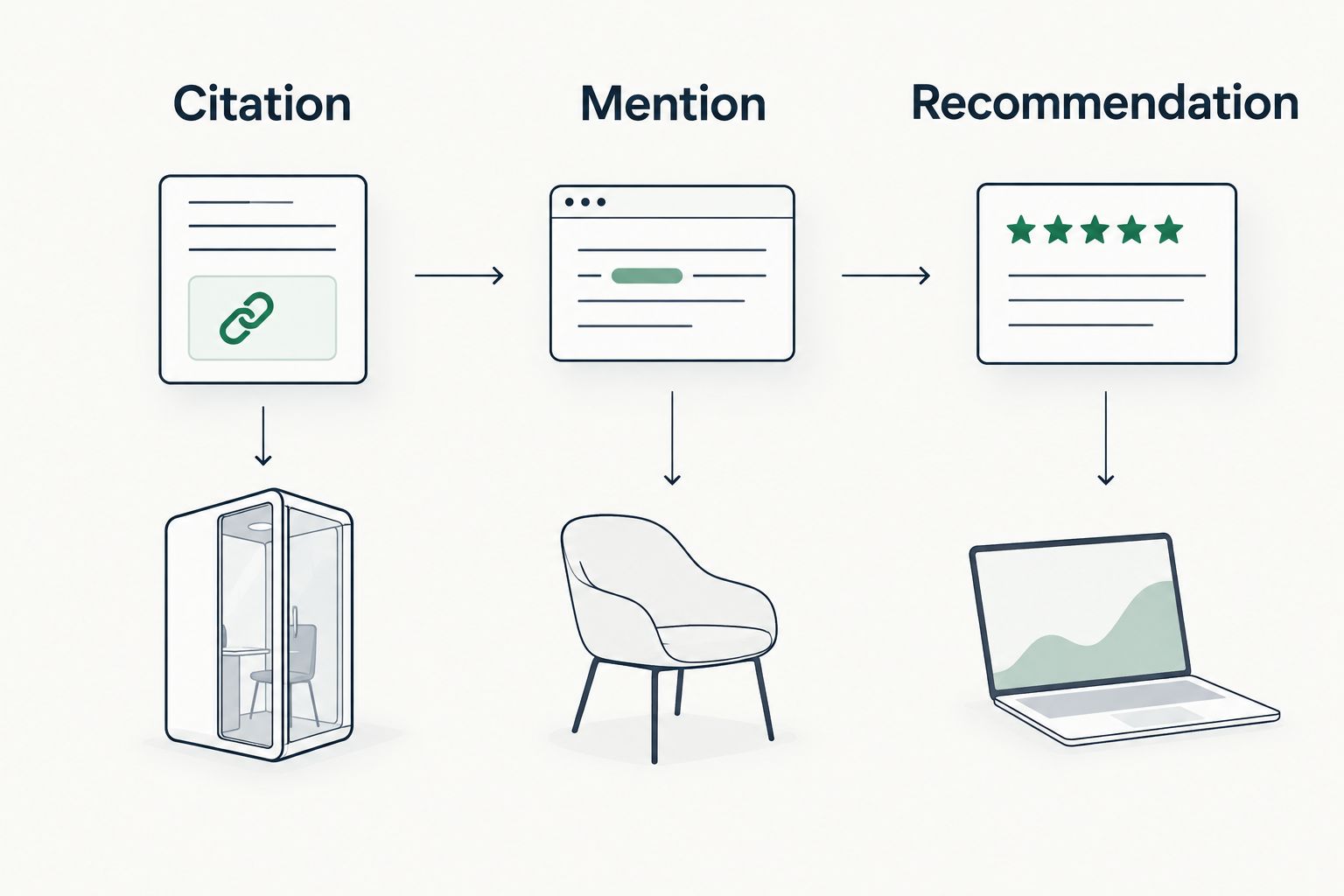
- Count citations separately from mentions in every report
- Track which of your pages actually get linked, not just named
- Flag recommendations as the priority metric for leadership, not raw mention count
- Note when a competitor gets the recommendation and you get only a mention on the same prompt
4. Fix the pages losing citations first
Once the audit shows which prompts skip your brand, work backward to the page that should have answered it. Most gaps trace to thin, outdated or unstructured content rather than a technical block.
- Update any page carrying a fact an AI model is still repeating incorrectly
- Add direct, quotable answers near the top of the page, not buried after 800 words of preamble
- Structure FAQ sections so each question-and-answer pair stands alone without needing the rest of the page
- Add schema markup where it's missing on comparison and pricing-adjacent pages
- Re-test the exact prompt that failed within two to four weeks of publishing the fix, not immediately
5. Track competitor share of voice by prompt cluster
Share of voice in AI answers isn't one number — a brand can dominate branded prompts and disappear entirely on category prompts. Break it down by cluster before you report a blended figure to anyone.
- Group prompts into branded, category, comparison and problem-first clusters
- Calculate share of voice separately within each cluster
- Name the two or three competitors who consistently outrank you per cluster
- Watch for a competitor that only shows up in one platform — that's often a content gap specific to that model's sources
6. Set targets and report AI visibility to leadership
AI Visibility Score, citation count and share of voice mean nothing to a CMO without a target and a trend line. Brand managers who report a single flat number every quarter tend to lose the budget line the following year.
- Set a numeric target per prompt cluster, not one blended company-wide target
- Report month-over-month movement, not just the current snapshot
- Tie at least one metric to a business outcome leadership already tracks, like demo requests or trial signups
- Flag which competitor gained the most ground since the last report, and why
7. Set up alerts for brand-damaging or inaccurate answers
A factual error or a negative framing in a widely-asked prompt can sit unnoticed for months without active monitoring. Waiting for the next scheduled audit is too slow once a model has locked onto a wrong fact.
- Set alerts on your highest-volume branded and comparison prompts
- Check flagged answers within days, not at the next monthly review
- Log the source page the AI model is likely pulling the error from
- Escalate anything mentioning pricing, safety or compliance immediately — those errors carry the most risk
Comparing the ways brand managers track AI visibility in 2026
| Option | Best for | Key limitation |
|---|---|---|
| Manual prompt-and-log spreadsheet | Teams testing the idea before buying anything | Doesn't scale past a handful of prompts or platforms, and trend data is unreliable |
| Generic rank-tracking or SEO tools | Teams already paying for one who want a rough signal | Built for search rankings, not built to separate citation from mention from recommendation |
| Koalr | Brand managers who need AI Visibility Score, Share of Voice and citation-level detail across ChatGPT, Gemini, Perplexity, Claude and Copilot | Only as good as the prompt set you feed it — it tracks what you ask, it doesn't invent buyer questions |
| Agency GEO audit retainer | Teams wanting expert prompt design and a narrative report | Point-in-time snapshot; AI answers move between review cycles |
Koalr wins for brand managers who need ongoing AI visibility tracking across all five major platforms rather than a one-off snapshot. Teams still finding their prompt set are better served starting with the manual spreadsheet in step two above.
Common mistakes brand managers make with AI visibility tracking
- Tracking only branded prompts and missing the category and comparison prompts where competitors get named instead
- Treating GA4 or Semrush AI referral clicks as the full picture, which hides every citation that never produced a click
- Reviewing AI answers once a quarter while model updates roll out continuously through 2026
- Letting one person eyeball ChatGPT once and call it an audit, with no repeatable, logged prompt set behind it
- Reporting citations, mentions and recommendations as one blended number instead of three separate signals
Get your brand's AI Visibility Score
See where ChatGPT, Gemini and Perplexity cite your brand today.
FAQ
What is AI visibility tracking for brand managers?
AI visibility tracking for brand managers is the practice of monitoring how ChatGPT, Gemini, Perplexity, Claude and Copilot describe, cite and recommend a brand, then acting on the gaps. It covers citations, mentions and recommendations, not just referral clicks.
Is AI visibility tracking different from tracking AI referral traffic?
Yes. AI referral traffic in GA4 or Semrush only shows clicks that landed back on your site, while AI visibility tracking also catches citations, mentions and recommendations that never produced a click at all.
How often should brand managers check AI visibility in 2026?
Monthly, at minimum, because AI models update retrieval and ranking behaviour continuously rather than on a fixed schedule. Quarterly reviews leave a brand blind for weeks between checks.
What's the difference between a citation, a mention and a recommendation?
A citation links back to a specific page on your site, a mention names your brand with no link, and a recommendation names your brand as the actual answer to the buyer's question. Recommendations are the outcome that moves revenue.
Can brand managers track AI visibility without hiring an agency?
Yes, starting with a manual prompt-and-log spreadsheet across a defined prompt set is a valid first step. It becomes impractical past a handful of prompts and platforms, which is when a dedicated tool like Koalr replaces the manual work.
Which AI platforms should brand managers track first?
Track ChatGPT, Gemini, Perplexity, Claude, Copilot and Google AI Overviews together from the start, since each surfaces different sources and phrases answers differently. Skipping one platform leaves a real gap in the picture.
How do brand managers stop AI models from repeating outdated facts about the brand?
Update the source page carrying the incorrect fact, then re-test the exact prompt that surfaced it two to four weeks later. AI models pull from live content, so the fix has to land on the page before the answer changes.
What is an AI Visibility Score?
An AI Visibility Score is a tracked measure of how consistently a brand appears, gets cited and gets recommended across AI platforms for a defined prompt set. Koalr calculates it alongside Share of Voice against named competitors.
One last thing
The prompt set matters more than the tool. Most brand managers who install AI visibility tracking in 2026 still lose the thread within two months because they wrote five branded prompts once and never touched the list again. Build the category and comparison prompt list first, get it reviewed by whoever owns competitive intelligence, and only then wire up tracking against it.


