

Track AI visibility for a free trial signup funnel by mapping prompts to each funnel stage, recording whether your brand is cited, mentioned or recommended, and comparing those outcomes with trial starts and downstream activation data. Keep AI visibility separate from referral traffic in 2026: an answer can influence a signup without producing a trackable click.
- Track AI visibility for a free trial signup funnel across problem, comparison, signup and post-signup prompts.
- Separate citations, mentions and recommendations because each signals a different level of influence.
- Compare AI Share of Voice with trial starts, but do not treat correlation as attribution.
- Koalr is best for marketing teams that need funnel-stage AI visibility across six named AI surfaces.
Why this matters
A free trial funnel usually starts before the website session. A prospect can ask ChatGPT which products solve a problem, use Gemini to compare options and consult Perplexity before choosing where to sign up. If your measurement begins at the landing page, every answer that shaped that decision remains outside the funnel report.
AI visibility is not the same as AI referral traffic. Referral analytics record visits that arrive through detectable links; visibility tracking records what an answer says, whether it names the brand and which source it cites. In 2026, you need both views because neither one explains the full journey alone.
The Koalr AI visibility platform is built for marketing teams that need to monitor how their brand appears in answers from ChatGPT, Gemini, Perplexity, Claude, Copilot and Google AI Overviews. Its fit is strongest when the team wants prompt-level citations and Share of Voice; its limitation is that visibility data still needs to be interpreted alongside product analytics rather than treated as direct signup attribution.
How to track AI visibility for a free trial signup funnel
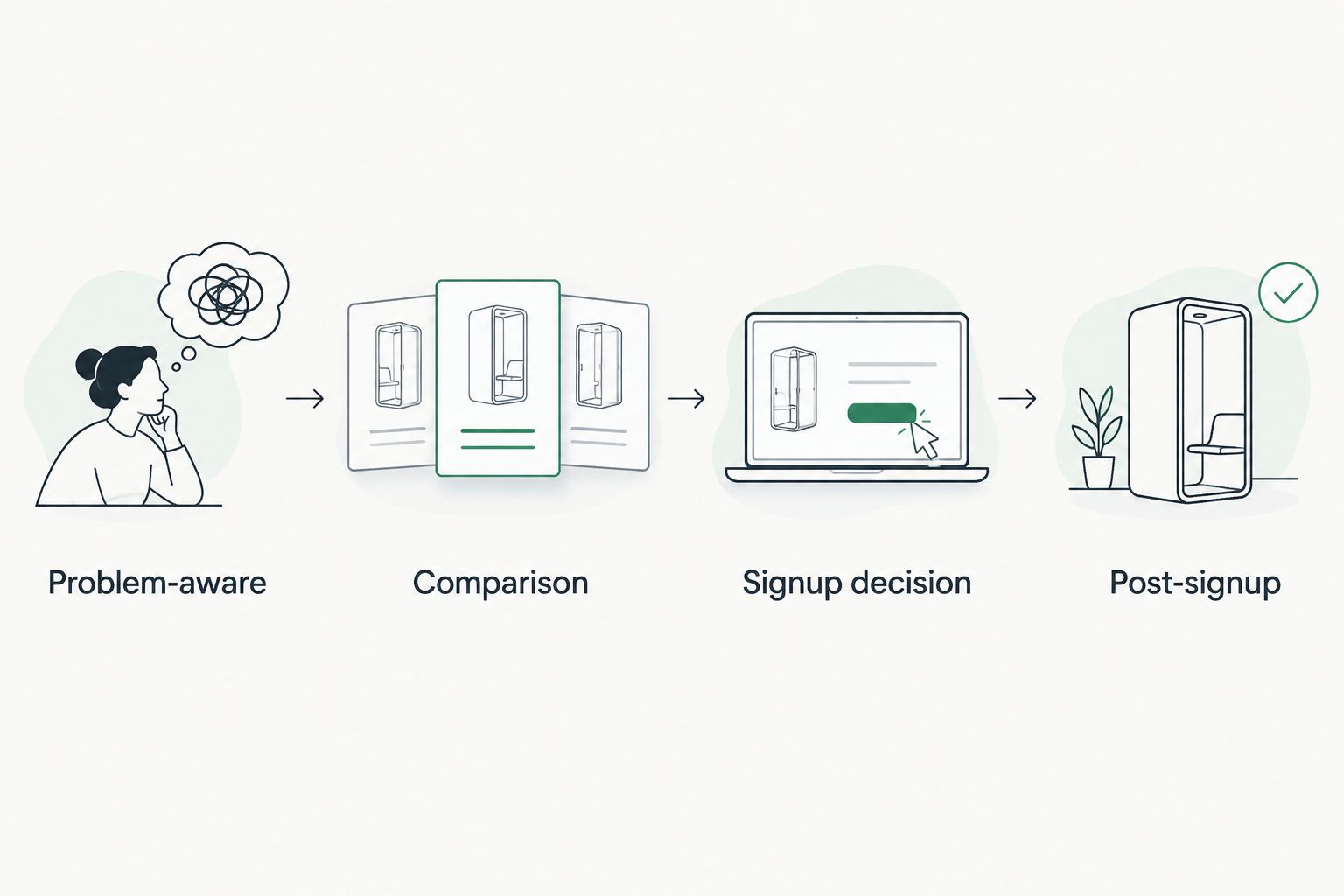
Use one scorecard with four funnel stages. Each stage needs a distinct prompt group, answer classification and business outcome.
| Funnel stage | Prompt intent | AI visibility signal | Funnel signal |
|---|---|---|---|
| Problem-aware | Understand or solve a problem | Relevant brand mention or citation | Qualified visit |
| Comparison | Evaluate products or approaches | Share of Voice and recommendation position | Trial-page visit |
| Signup decision | Confirm fit before registering | Accurate mention, citation or recommendation | Trial start |
| Post-signup | Configure, evaluate or troubleshoot | Accurate guidance and cited source | Activation or continued use |
The table is a measurement map, not an attribution model. It shows where AI visibility belongs beside the funnel, while keeping the answer data and product data separate.
1. Define the conversion event
Start with the event that marks a completed free trial signup. Use the same event definition in product analytics, web analytics and reporting so the team is not comparing different versions of a trial start.
Document the page, event name and conditions required for a valid signup. Exclude internal tests and duplicate events using the controls already available in your analytics setup. The aim is a stable denominator, not a larger number.
2. Split the funnel into four prompt stages
Create separate prompt groups for problem discovery, comparisons, signup decisions and post-signup use. A single list of brand prompts cannot show where the brand disappears because branded questions already assume awareness.
For each stage, include branded and unbranded language. Branded prompts test factual accuracy about the product; unbranded prompts test whether the product enters consideration without being named first. Keep those groups separate in every 2026 report.
3. Build prompts from real buyer questions
Use questions found in sales conversations, support requests, search queries, comparison pages and product research. Rewrite them only enough to remove private details and preserve the original intent.
A problem-aware prompt should describe the job without naming your product. A comparison prompt should request options or distinctions. A signup-decision prompt should ask whether a named product fits a use case, while a post-signup prompt should reflect setup, evaluation or troubleshooting intent.
Do not pad the library with minor rewordings of the same question. Prompt coverage matters more than superficial prompt volume because repeated phrasing can make one topic look more important than it is.
4. Run the same prompts across six AI surfaces
Test the fixed prompt set across ChatGPT, Gemini, Perplexity, Claude, Copilot and Google AI Overviews. Keep the wording stable during each reporting period so a changed answer is not confused with a changed question.
Record the platform, prompt, answer date, brand appearance, competitor appearances, recommendation language and cited sources. AI answers can vary between runs, so the report should preserve the answer evidence rather than storing only a summary score.
5. Classify every brand appearance
Use three mutually distinct labels:
- Mention: the answer names the brand but provides no source for the claim.
- Citation: the answer connects the brand or claim to a referenced source.
- Recommendation: the answer explicitly presents the brand as a suitable choice for the stated need.
A recommendation can also contain a citation, but those fields should remain separate. The recommendation records the answer’s judgement; the citation records its supporting source. Combining them hides whether the brand is merely documented or actively preferred.
6. Calculate stage-level visibility
Report visibility by funnel stage before calculating an overall score. At minimum, the scorecard should show prompt coverage, brand mentions, citations, recommendations, cited domains and competitor appearances.
Share of Voice adds the competitive view. It shows how often your brand appears relative to the competitors included in the same answers and prompt set. Keep the competitor set and calculation method fixed between reporting periods; changing either one breaks the comparison.
A single overall visibility score is useful for reporting direction, but it cannot diagnose the problem alone. If the overall score falls, stage-level data tells you whether the loss occurred during discovery, comparison, signup evaluation or post-signup support.
7. Join visibility trends to funnel data
Place AI visibility metrics beside qualified visits, trial-page visits, completed signups and activation events. Compare movement by reporting period and campaign, but do not claim that a citation caused a signup unless the journey contains evidence connecting the two.
Use AI referral traffic as supporting evidence, not as the definition of visibility. Referral sessions capture only visits with a detectable source. A prospect can read an answer, remember the brand and visit through search or a direct URL, leaving no AI referral marker.
8. Turn gaps into specific fixes
Every weak prompt cluster should produce an action tied to the observed answer. If the brand is absent, identify which competitors and source pages appear instead. If the brand is mentioned without a citation, strengthen the page that supports the relevant claim. If an answer contains a factual error, correct the source content and monitor the prompt for change.
Do not respond to every missing citation by publishing another generic article. The required fix can be clearer product information, a direct comparison, structured answers, stronger third-party corroboration or more precise language on an existing page.
Find your funnel visibility gaps
Track citations, recommendations and Share of Voice across your prompt set.
Why AI visibility varies across the funnel
- Prompt intent: problem-solving, comparison and signup questions ask AI systems to perform different tasks.
- Branded versus unbranded wording: naming the product tests known-brand accuracy, while omitting it tests category discovery.
- Platform coverage: ChatGPT, Gemini, Perplexity, Claude, Copilot and Google AI Overviews can return different sources and brand sets.
- Source clarity: a page that answers the exact question gives an AI system a clearer passage to cite than a page that buries the answer.
- Competitive coverage: a competitor can dominate one prompt cluster while remaining absent from another.
- Prompt-set composition: overloading the library with one topic distorts the overall AI Visibility Score and hides weaker stages.
These factors explain why the same SaaS brand can look strong in a general visibility report but disappear immediately before the free trial signup. Stage-level reporting exposes that gap.
Which metrics belong in the scorecard?
Use metrics that answer separate questions rather than repeating the same signal under different names.
| Metric | Question it answers | Main limitation |
|---|---|---|
| Mention rate | Does the brand appear? | Does not show support or preference |
| Citation rate | Is the brand connected to a source? | Does not prove the answer recommends it |
| Recommendation rate | Is the brand presented as a suitable choice? | Depends heavily on prompt intent |
| Share of Voice | How visible is the brand relative to competitors? | Changes if the prompt or competitor set changes |
| AI referral traffic | Did a detectable AI link produce a visit? | Misses influence without a click |
| Trial conversion rate | Did visits become trial signups? | Does not identify unseen upstream answers |
Koalr is best for marketing teams that need prompt-level AI visibility connected to a free trial funnel, not teams looking for a replacement for product analytics. That distinction keeps the 2026 measurement model honest: Koalr shows what AI systems say, while the analytics stack shows what visitors do.
How often should the prompt set be reviewed?
Use a fixed monitoring cadence and review the prompt library whenever the product, positioning, buyer language or competitor set changes. Keep a stable core for trend reporting, then add a clearly labelled temporary group for launches or campaigns.
A 2026 baseline is only useful if the prompts remain comparable. Replacing weak-performing prompts with easier branded questions improves the score without improving market visibility.
Can AI visibility be attributed directly to free trial signups?
Not from visibility data alone. A citation, mention or recommendation shows that the brand appeared in an answer, while a completed signup shows that a person entered the trial; connecting them requires journey evidence rather than timing alone.
Use referral parameters where available and compare directional changes across consistent periods. Report the rest as influence or correlation, not attributed conversion.
What should you do when a competitor wins the comparison stage?
Inspect the exact prompts, recommendation language and cited sources where the competitor appears. Then fix the information gap behind that result instead of copying the competitor’s wording or publishing a broad response with no connection to the prompt.
A useful 2026 action list names the affected prompt cluster, the competing brand, the source being cited, the page to improve and the answer outcome to monitor. That turns Share of Voice into editorial and product-marketing work.
FAQ
How do you track AI visibility for a free trial signup funnel?
Map prompts to problem-aware, comparison, signup-decision and post-signup stages, then record mentions, citations, recommendations and competitor appearances. Compare those visibility trends with trial and activation data without claiming unsupported attribution.
Is AI referral traffic the same as AI visibility?
No. AI referral traffic records detectable visits from AI answers, while AI visibility records brand appearances whether or not the answer produces a click.
Which AI platforms should a SaaS marketing team monitor?
Monitor the platforms relevant to the audience, including ChatGPT, Gemini, Perplexity, Claude, Copilot and Google AI Overviews. Use the same core prompts across each surface so the results remain comparable.
What is the difference between an AI mention and a citation?
A mention names the brand without connecting it to a referenced source, while a citation links the brand or claim to supporting material. Track them separately because they indicate different answer behaviour.
What is an AI recommendation?
An AI recommendation explicitly presents a brand or product as suitable for the user’s stated need. It is stronger than a neutral mention, but it still does not prove the user visited or signed up.
Can GA4 measure AI visibility?
GA4 can measure attributable visits and on-site events, not every brand appearance inside an AI answer. Pair web analytics with prompt-level monitoring to cover both traffic and visibility.
How should branded and unbranded prompts be reported?
Report branded and unbranded prompts as separate groups. Branded prompts test factual accuracy, while unbranded prompts test whether the brand enters category consideration without being named first.
What should a 2026 AI visibility report include?
Include the fixed prompt set, monitored platforms, mentions, citations, recommendations, cited sources, competitor appearances and Share of Voice by funnel stage. Add trial metrics beside them without merging visibility and conversion into one unsupported attribution figure.
One last thing
Do not stop measurement at the signup confirmation. Post-signup prompts reveal whether AI assistants help a trial user understand the product or introduce competing options while that user is still evaluating it. For Koalr customers, this stage belongs in the same 2026 prompt framework as discovery and comparison because the trial is part of the buying process, not the end of it.


