
Track AI visibility around a merger or acquisition by baselining citation counts, share of voice and sentiment for both brand names before the deal is announced, then re-running the same prompt set weekly through close and for at least one full quarter after. The number to watch is how often AI answers still name the acquired company on its own, months after the deal has closed. That lag is the hidden cost the "we're now one company" press release doesn't show: AI platforms rebuild their answer graphs on their own schedule, not yours.
- Track AI visibility around a merger or acquisition by baselining both brand names before the announcement, not after.
- AI platforms keep citing the acquired brand's old name for weeks or months after close — check weekly.
- Share of voice splits between the acquirer and target during the deal; watch which name AI answers pick.
- Live-retrieval platforms like Perplexity and Copilot update faster than training-based platforms like ChatGPT and Claude.
Why this matters
A merger changes what your brand is called, who runs it and what it sells — but AI platforms only reflect that once their training data and retrieval indexes catch up. Koalr exists to close that exact gap: tracking which platforms still name the acquired company, which cite the new one, and where the two get blended into a single wrong answer.
Until the indexes catch up, ChatGPT, Gemini, Perplexity, Claude and Copilot answer questions about the deal with whatever they crawled last — outdated leadership names, dropped product lines, or the acquired brand credited to a parent that no longer owns it. That gap matters more for AI answers in 2026 than it did for a plain Google search result, because a search result you can fix with a canonical redirect. An AI answer regenerates fresh each session from training data plus live retrieval, so a wrong fact can resurface in a customer's chat weeks after your own site is correct.
How to track AI visibility around a merger or acquisition
Run this as a five-step process in 2026, not a one-time check:
- Baseline both names before the announcement. Run the same prompt set — "who owns [acquired brand]", "is [acquired brand] part of [acquirer]", "[acquired brand] vs [acquirer]" — across ChatGPT, Gemini, Perplexity, Claude and Copilot before the deal goes public. Record the AI Visibility Score and share of voice for each name separately.
- Re-run the prompt set the day the deal is announced. Platforms with live retrieval move first. Others sit still until their next training or index refresh.
- Track name collisions weekly through close. Watch for answers that cite the acquired brand and the acquirer in the same sentence with the ownership direction wrong — that's the single most common M&A-era AI error.
- Check factual details, not just the name. Product lines, leadership, headquarters and "who do I contact" answers all go stale independently of the brand name itself. A platform can get the corporate name right and still cite a product the acquirer already discontinued.
- Keep tracking for at least one quarter after close. Citation graphs don't snap to the new reality on close day. They drift toward it over the following weeks as crawlers revisit pages and models get their next refresh.
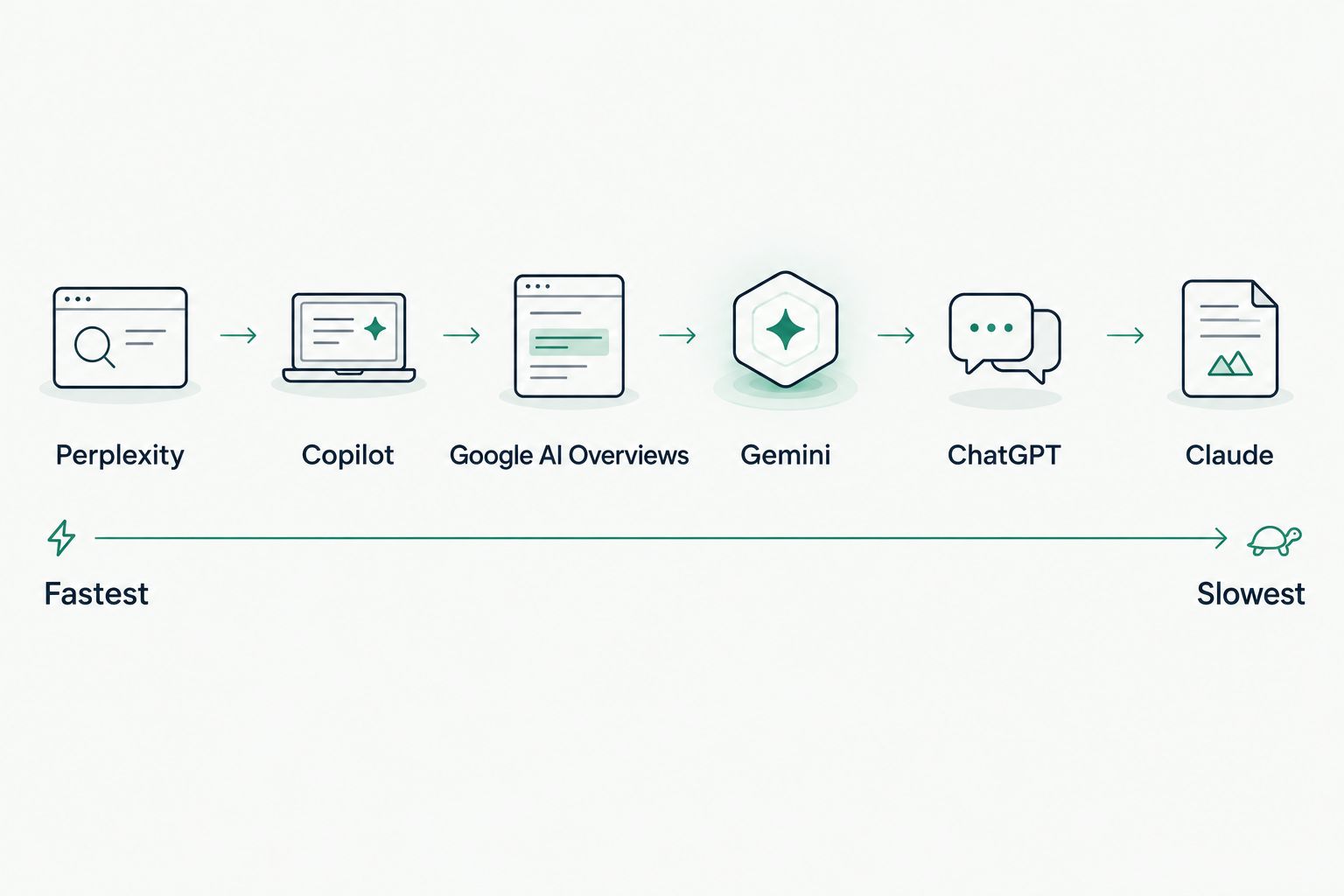
Here's how the major platforms tend to differ on update speed, based on how each one sources answers:
| Platform | Update mechanism | Typical lag after a public deal |
|---|---|---|
| Perplexity | Live web retrieval | Hours to days |
| Microsoft Copilot | Live web + Bing index | Hours to days |
| Google AI Overviews | Live index + generated summary | Days to weeks |
| Gemini | Training data + Google index blend | Days to weeks |
| ChatGPT | Training data + limited live browsing | Weeks to next model refresh |
| Claude | Training data, limited live retrieval | Weeks to next model refresh |
Before the announcement: set a citation baseline
Nail down what AI platforms say about the acquired brand before anyone outside the deal team knows it's happening. This is the only clean baseline you'll get — once the news breaks, every subsequent answer is already reacting to the deal.
Capture at minimum: the AI Visibility Score for each brand name on its own, the share of voice each name gets against its known competitors, and the sentiment of any answers that already mention acquisition rumors. If your prompt set doesn't cover ownership and "who owns" questions yet, build one out before the baseline run, not after — a baseline taken the day the deal leaks is not a baseline.
During the deal: watch for stale citations and name confusion
Between announcement and close, AI answers go through their messiest phase. Some platforms have already updated; others are still citing the acquired company as fully independent, sometimes years-old coverage getting recirculated as current.
Two failure patterns show up repeatedly in 2026 M&A tracking work:
- An AI answer names the acquirer as owning the acquired brand before the deal has actually closed, based on leaked or rumored coverage.
- An AI answer keeps the acquired brand fully independent weeks after close, ignoring the announcement entirely.
Both versions mislead a prospect or journalist asking a direct ownership question. Both are worth flagging at the source-content level, not just noting in a dashboard.
After close: track the new entity's share of voice
Once the deal closes, the tracking question changes from "does the platform know about the deal" to "who wins the answer." If the acquired brand keeps its name as a product line or sub-brand, you're now running multi-brand portfolio tracking rather than a single-brand watch — each name needs its own prompt set and its own share-of-voice number, because AI answers frequently keep treating them as separate competitors long after the org chart says otherwise.
If the acquired brand is being folded into the acquirer's name entirely, the tracking work looks closer to tracking AI visibility through a company rebrand: same core question, different mechanism. You're waiting for AI platforms to stop citing a name that no longer exists at all, rather than reconciling two names that both still exist.
“If ChatGPT still cites the acquired brand as independently owned a quarter after close, the citation graph hasn't caught up with the deal — and neither has your team, unless someone's checking.”
Why AI visibility drifts differently for every deal
Not every merger produces the same tracking picture. A few factors decide how fast, and how cleanly, AI answers catch up:
- Deal size and press coverage. A heavily covered acquisition gets crawled and cited faster than a quiet acquihire that barely made the trade press.
- Whether the acquired brand keeps its name. Dropped names take longer to disappear from AI answers than kept names take to gain updated ownership context.
- How much of the acquired brand's own content survives. If its site gets redirected or taken down at close, AI platforms lose the source they'd otherwise cite for corrections.
- Platform-specific retrieval behavior, as shown in the table above — live-retrieval platforms move faster than training-based ones.
- How many third-party sites still describe the old structure. Wikipedia, Crunchbase, industry directories and news archives all feed AI training and retrieval, and none of them update the moment your press release goes out.
- Whether anyone is actively checking for factual errors in the resulting answers — errors that go unflagged tend to persist into the next training cycle.
Does ChatGPT update automatically after a company merger?
No — ChatGPT does not update automatically after a company merger. It depends on browsing features or the next base model refresh to pick up new ownership facts, and until then it answers from training data that predates the deal. Perplexity and Microsoft Copilot, by contrast, pull from live web retrieval and can reflect a merger within hours of a public announcement.
How long does an acquired brand's old name stay in AI answers?
An acquired brand's old name can stay in AI answers for weeks or months after a deal closes, mixed in with corrected mentions of the new owner. The exact lag depends on how much third-party coverage — news, Wikipedia, directories — has been updated, since that coverage is what live-retrieval platforms cite and what future training runs absorb.
Can AI answers cite outdated products from the acquired company?
Yes — AI answers can cite outdated products from the acquired company even after the ownership fact is correct, because product-level content updates lag behind corporate-level press coverage. A prompt asking "does [acquired brand] still make [product]" is a separate tracking question from "who owns [acquired brand]" and needs its own check.
Start tracking your deal's AI visibility
Baseline both brand names before the news breaks.
FAQ
What's the best way to track AI visibility around a merger or acquisition in 2026?
The best way to track AI visibility around a merger or acquisition in 2026 is to baseline both brand names before the announcement, then re-run the same prompt set weekly through close and for at least one quarter after. That schedule catches the slow platforms as well as the fast ones.
Is Perplexity faster than ChatGPT at reflecting a merger?
Yes, Perplexity is typically faster than ChatGPT at reflecting a merger because it pulls from live web retrieval rather than relying on a fixed training snapshot. ChatGPT usually waits for its next base model or browsing-index refresh.
What happens if AI answers keep citing the wrong owner after a merger closes?
If AI answers keep citing the wrong owner after a merger closes, prospects and journalists asking direct ownership questions get an outdated answer that can undercut a press announcement. The fix is flagging the source content the platform is drawing from, not just noting the error.
Should a rebrand and a merger be tracked with the same prompt set?
No, a rebrand and a merger need related but separate prompt sets. A merger tracks two names that both still exist; a rebrand tracks one name disappearing entirely, which is a different citation pattern to watch for.
Do AI platforms treat an asset acquisition differently from a full merger?
AI platforms don't distinguish deal structure directly, but the practical effect differs: an asset acquisition often leaves the acquired brand's site and content live longer, which gives AI platforms a stale source to keep citing longer than a full merger where the site gets folded in immediately.
How often should AI visibility be checked during an active M&A deal?
AI visibility should be checked weekly during an active M&A deal, from the announcement through at least a quarter past close. Daily checks rarely show new movement; monthly checks miss the window when name confusion is most common.
Can a press release fix an AI answer immediately?
No, a press release cannot fix an AI answer immediately. Live-retrieval platforms like Perplexity and Copilot may reflect it within hours, but training-based platforms like ChatGPT and Claude only pick it up at their next refresh, which can be weeks or months out.
Is AI visibility tracking different from tracking AI referral traffic during a merger?
Yes, AI visibility tracking is different from tracking AI referral traffic during a merger. Referral traffic tools only show clicks that came from an AI answer; they miss every citation that named the wrong owner and never produced a click at all.
One last thing
The riskiest window isn't the day the deal is announced. It's the 60 to 90 days after close, when press coverage has dried up but AI platforms haven't finished absorbing the new corporate structure, and most teams have already stopped watching. In 2026, that's the exact stretch where a customer's ChatGPT session can still return the acquired brand as an independent company, months after the ownership changed.


