

Demand generation teams' AI visibility tracking is the process of measuring how a brand appears in AI-driven answers with the aim of turning citation gaps into pipeline-focused campaign priorities. Koalr is best for demand generation teams that need to compare brand citations, recommendations and competitor share of voice across AI answer engines.
- AI visibility tracking for demand generation teams connects answer-engine visibility with funnel stages and campaign priorities.
- Koalr is best for comparing brand citations, recommendations and competitor visibility across six AI surfaces.
- Track citations, mentions and recommendations separately because each describes a different level of buyer exposure.
- Use three funnel stages and a fixed prompt set so changes remain comparable throughout 2026.
Why this matters
Demand generation teams cannot measure AI visibility through referral traffic alone. Analytics platforms record a visit after somebody clicks, but they do not show an answer that named a competitor, cited your page without generating a visit or excluded your brand completely.
That blind spot affects campaign planning. A buyer can use ChatGPT, Gemini, Perplexity, Claude, Copilot or Google AI Overviews to research a category before reaching your website. If the answer presents competitors and omits your brand, the missed demand leaves no conversion event for your analytics platform to record.
AI visibility tracking fills that gap in 2026 by recording what each answer says, which source it cites and how your brand compares with named competitors. The result is not another traffic report. It is an evidence set for choosing content updates, campaign themes and competitive responses.
Why AI visibility tracking matters for demand generation teams
Demand generation teams need to measure visibility against buyer intent. A broad informational prompt and a direct vendor-comparison prompt do not carry the same commercial meaning, even when both mention the same category.
The practical structure uses three funnel stages: discovery, evaluation and decision. Discovery prompts expose category demand, evaluation prompts reveal shortlist formation, and decision prompts show whether the brand survives direct comparison. This structure gives every citation gap an owner and a next action in 2026.
A useful report also separates three answer outcomes:
- A mention names the brand without presenting it as evidence or a preferred option.
- A citation points to the brand or its content as a source for a claim.
- A recommendation presents the brand as an option suited to the user's stated need.
Those outcomes should not be merged into one visibility total. A recommendation on a decision-stage prompt carries a different campaign implication from a passing mention in a discovery answer.
How to track AI visibility for demand generation
Build prompts from the buying journey
Start manually with the questions buyers ask during discovery, evaluation and decision. Use sales-call themes, search queries, campaign briefs, customer interviews and competitor comparisons already available to the team. Do not begin with a list of generic category keywords detached from the buying process.
Keep one row per prompt in a shared sheet. Add columns for funnel stage, audience, product area, market and campaign owner so every result can be segmented without rebuilding the prompt set later. The 2026 baseline must stay stable enough to support valid comparisons.
- Include category-definition questions used during discovery.
- Add use-case questions tied to the buyer's operating problem.
- Capture comparison questions that name relevant alternatives.
- Include decision questions about fit, implementation and selection criteria.
- Record the source that justified adding each prompt.
The guide to building a prompt library for AI visibility tracking provides a separate framework for organising these questions.
Assign intent and ownership before collecting answers
Classify each prompt before examining the results. Scoring prompts after seeing which brands win introduces bias and makes the report harder to defend. A simple manual label for discovery, evaluation or decision is enough to establish the first baseline.
Ownership matters just as much as intent. Demand generation can own campaign prompts, while product marketing or content teams own the page changes required to improve an answer. The report should identify both the metric owner and the action owner.
- Label every prompt with one funnel stage.
- Assign one audience or account segment.
- Connect each prompt to a campaign or content theme.
- Name the team responsible for investigating a loss.
- Freeze the baseline labels for the reporting period.
Capture the complete answer evidence
Run the fixed prompt set manually across the AI surfaces your buyers use. Save the complete answer, the brands named, the sources cited and the date checked. A copied brand mention without its surrounding answer loses the evidence needed to understand why the model selected it.
Once manual checks become difficult to repeat consistently, Koalr provides the faster path by helping marketing teams track and improve how their brand appears across ChatGPT, Gemini, Perplexity, Claude, Copilot and Google AI Overviews. The platform still depends on a relevant prompt set; software cannot repair weak measurement design.
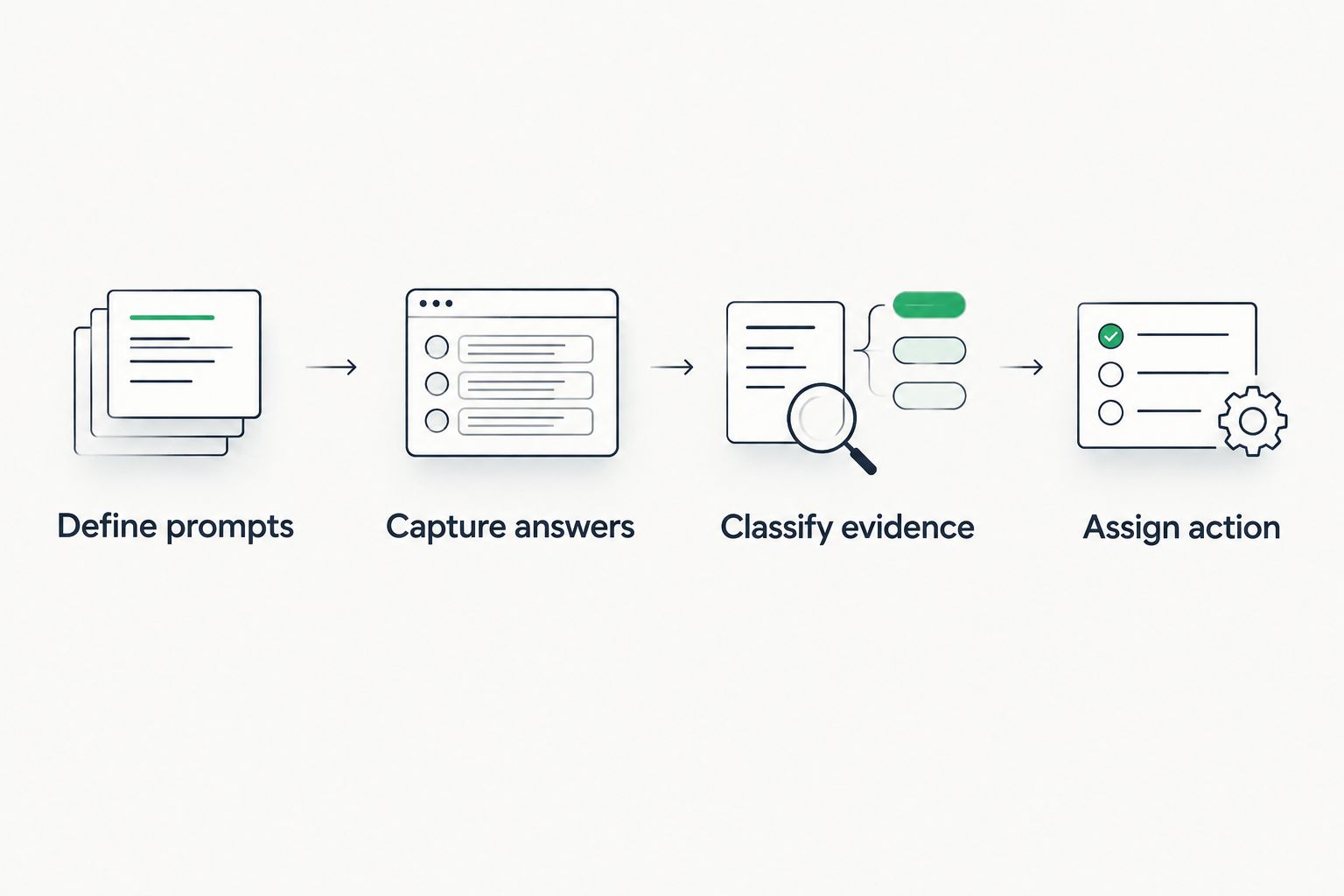
The collection sequence is straightforward: define prompts, capture answers, classify evidence and assign action. Keep the same sequence across every 2026 review.
- Store the complete answer rather than an isolated sentence.
- Record the AI platform and check date.
- Mark every brand mention, citation and recommendation separately.
- Save the cited source when the answer provides one.
- Note factual errors as a distinct issue requiring correction.
Compare competitors on identical prompts
Competitor share of voice only means something when every brand is assessed against the same prompts, platforms and reporting period. Do not create easier prompts for your brand or use a separate competitor sample. That produces two datasets that cannot support a direct comparison.
Read the winning answer closely. Identify the claim, evidence type or page cited beside the competitor. That evidence is more useful than the loss itself because it points towards the content gap demand generation should brief.
- Use the same prompt wording for every tracked brand.
- Record competitors that appear without being preselected.
- Separate cited competitors from brands that are only mentioned.
- Note the source type supporting each winning answer.
- Prioritise losses on evaluation and decision prompts.
Connect visibility gaps to campaign work
A visibility report becomes useful when each material gap changes the campaign plan. Group losses by recurring buyer need, weak proof, missing comparison coverage or factual inconsistency. Then assign the smallest content or distribution action capable of addressing the pattern.
Do not respond to every missing citation with a new article. Existing product pages, comparison pages, research, FAQs or third-party references can be the better intervention. The answer evidence determines the format.
- Refresh a page when the correct topic exists but the evidence is unclear.
- Create comparison content when buyers repeatedly ask about alternatives.
- Clarify factual statements when AI answers reproduce inconsistent information.
- Strengthen original evidence when competitors win with cited proof.
- Add the chosen action to the active campaign calendar.
Report two layers to leadership
Use two reporting layers in 2026. The operational layer shows prompt-level evidence for the teams making changes. The leadership layer shows the direction of visibility, the funnel stages affected, the competitors gaining ground and the actions underway.
Avoid presenting one score without its components. A stable overall result can conceal a decline in decision prompts and an increase in low-intent mentions. Leadership needs the commercial interpretation, not a table of every answer collected.
- Show citations, mentions and recommendations as separate measures.
- Break results out by discovery, evaluation and decision.
- Name the competitors gaining visibility on priority prompts.
- Connect each material change to an assigned response.
- Review the operational evidence on a fixed 4-week cadence.
Options for demand generation teams
The right tracking method depends on the breadth of the prompt set and the level of evidence the team needs. Every option has a valid use case, but they do not answer the same question.
| Option | Best for | Key limitation |
|---|---|---|
| Manual prompt checks | A team establishing its first baseline and refining prompt relevance | Repeating checks across platforms is time-consuming, and answer evidence becomes difficult to compare |
| Referral analytics | Measuring visits that arrive after a user clicks from an AI platform | Cannot reveal unclicked citations, recommendations or competitor-only answers |
| Koalr | Demand generation teams comparing brand appearance across multiple AI-driven answer surfaces | Requires a disciplined prompt set and clear ownership before the output becomes actionable |
Koalr wins for recurring AI visibility tracking, while manual checks remain the right starting point for validating the prompt set. Referral analytics should stay in the reporting stack, but it measures traffic after exposure rather than the exposure itself.
Track your AI visibility
Compare how your brand appears across major AI-driven answer surfaces.
Common mistakes demand generation teams make
- Treating every prompt as equally valuable. Discovery prompts and decision prompts represent different buyer needs. Report them separately so a rise in broad mentions does not hide lost recommendations near the point of selection.
- Using referral traffic as the visibility total. Referral data begins after a click. It cannot show how often an answer cited the brand without a visit, recommended a competitor or supplied no source link.
- Changing prompts during every review. Constant edits destroy the baseline. Maintain a stable core set in 2026 and place new campaign prompts in a clearly labelled expansion group.
- Reporting a score without answer evidence. A score shows that something changed. The stored answer, cited source and competitor context show what the team needs to fix.
- Sending every gap to the content team. Some losses come from unclear positioning, inconsistent product information or weak third-party evidence. Assign the issue to the team capable of changing the underlying signal.
FAQ
What is AI visibility tracking for demand generation teams?
AI visibility tracking for demand generation teams measures how a brand is mentioned, cited and recommended in AI-driven answers across buyer-journey prompts. The findings turn missed visibility into campaign, content and competitive actions.
What is the difference between an AI mention and a citation?
A mention names the brand, while a citation identifies the brand or its content as a source for a claim. A recommendation goes further by presenting the brand as suitable for the user's stated need.
Which AI platforms should demand generation teams track in 2026?
Track the platforms your buyers use, with ChatGPT, Gemini, Perplexity, Claude, Copilot and Google AI Overviews forming a practical cross-platform set. Keep the prompt wording and classification consistent across each surface.
Can referral analytics measure AI visibility?
Referral analytics measures visits generated after a user clicks from an AI platform, not total AI visibility. It cannot reveal answers that cited the brand without a click, recommended a competitor or omitted the brand.
How should demand generation prompts be organised?
Organise demand generation prompts into discovery, evaluation and decision stages. Add audience, product area, market and campaign ownership so each visibility gap can be assigned correctly.
How often should AI visibility be reviewed?
Use a fixed 4-week operational review to compare the stable prompt set and assign actions. Keep the cadence consistent so the team can distinguish meaningful movement from changes caused by irregular checking.
Is Koalr better than manual AI visibility tracking?
Koalr is better for recurring cross-platform tracking, while manual checks are useful for validating an initial prompt set. The software speeds collection and comparison, but the team still needs relevant prompts and clear ownership.
One last thing
Do not optimise solely for being named. A recommendation supported by a relevant citation is more useful to demand generation than an unexplained mention, while a confidently stated factual error creates a separate correction task. Keep those outcomes distinct in every 2026 report and assign different responses to each one.
The strongest next move is to review decision-stage losses first. They expose the moments where an AI answer is actively shaping a shortlist, making them clearer campaign priorities than broad visibility changes with no identifiable buyer action.


