
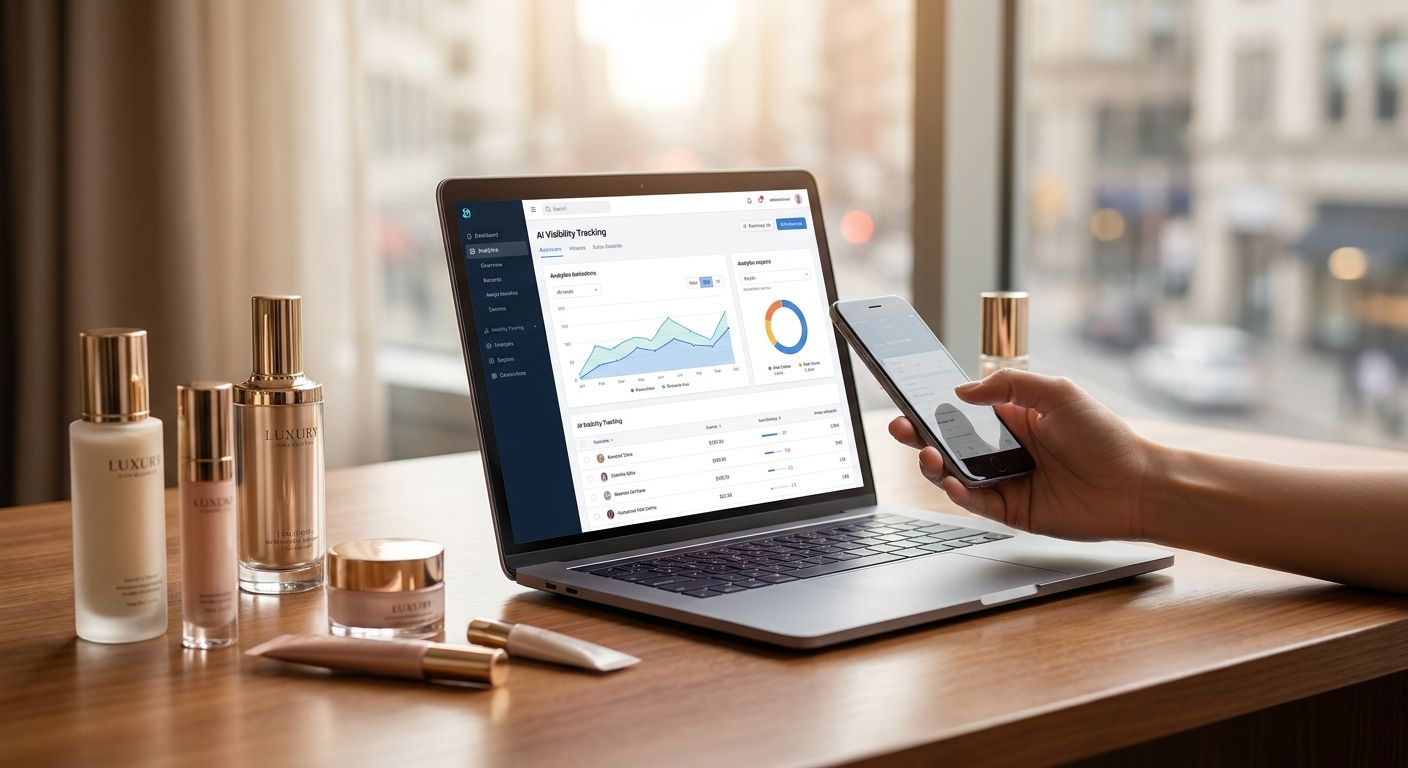
AI visibility tracking for beauty brands means running a fixed set of skincare, makeup and haircare prompts through ChatGPT, Gemini, Perplexity, Copilot and Google AI Overviews on a repeat schedule, then logging whether your brand gets named, cited as a source, or recommended outright each time. Beauty search is ingredient-led and trend-driven, so the prompt set for a serum brand goes stale faster than the one for a B2B software vendor.
- AI visibility tracking for beauty brands means testing category prompts like 'best vitamin C serum for sensitive skin' on a repeat cycle, not a one-off check.
- A mention, a citation and a recommendation are three different outcomes worth tracking separately, not one metric.
- Koalr runs recurring prompt sets across ChatGPT, Gemini, Perplexity, Copilot and Google AI Overviews so beauty teams don't rebuild the test by hand each month.
- Ingredient and skin-type queries shift faster than branded queries in beauty, so audit cadence matters more here than in most segments.
- Manual spreadsheet testing works to start; AI visibility tracking software becomes necessary once you're covering more than a handful of prompts a month.
Why AI visibility tracking matters for beauty brands
A shopper asking an AI assistant "what's a good retinol for beginners" is not typing your brand name. They're describing a concern, and the assistant picks the answer. If it names three brands and yours isn't one of them, you lost that conversion before your site ever showed up in a search result.
Beauty is one of the more crowded categories for this problem. DTC skincare, legacy CPG lines, and private-label brands all compete for the same ingredient and skin-type prompts, and AI assistants tend to default to a short list of repeatedly-cited names. Koalr exists to show marketing teams exactly which prompts surface their brand, which surface competitors instead, and where the gap is fixable with content versus where it's a structural authority problem.
The trend cycle makes this worse. An ingredient that spikes on social media in one quarter of 2026 can reshape which brands AI models cite for that concern within weeks, well before a traditional SEO audit would catch the shift.
Update your prompt set for beauty-specific search behavior
Branded prompts ("is [Brand] good for oily skin") only tell you half the story. Category prompts are where most of the competitive damage happens, and they need their own list.
- Concern-based prompts: "best moisturizer for rosacea-prone skin"
- Ingredient-based prompts: "best niacinamide serum 2026", "is squalane better than hyaluronic acid for dry skin"
- Occasion-based prompts: "best makeup setting spray for humid weather"
- Comparison prompts naming two or more brands directly
- Skin-type modifiers layered onto each of the above (sensitive, combination, mature, acne-prone)
Run the audit manually before you buy anything
The free version of this works, it just doesn't scale. Open ChatGPT, Gemini, Perplexity and Copilot in separate tabs, run the same 15-20 prompts through each, and record the output in a spreadsheet.
- Log the exact prompt text, the platform, and the date
- Note whether your brand appears at all
- Note whether it's named only, linked as a source, or presented as the top recommendation
- Note every competitor brand that appears alongside yours
- Repeat monthly, since AI model outputs shift with each update
This manual pass is exactly what a first AI visibility tracking for D2C brands audit should look like before a beauty team invests in software.
Test which prompts actually trigger your brand name
Not every prompt variation produces the same result, and the differences are where the fixable content gaps live. A prompt phrased "best drugstore vitamin C serum" might surface your brand while "best vitamin C serum under $20" doesn't, even though both describe the same product.
Running controlled variations against a single product page tells you which phrasing patterns the AI model associates with your content. The full method for this is in how to test if a prompt triggers your brand in AI answers, and it applies directly to ingredient and concern-based beauty queries.
- Test price-qualified versions of the same prompt ("under $30", "drugstore", "luxury")
- Test skin-type qualified versions separately
- Test the same prompt with and without a season or trend term attached
- Record which product page or ingredient page, if any, the AI model appears to be pulling from
Measure share of voice against your direct competitors
Appearing in an answer is not the same as winning it. If a prompt returns five brand names and yours is fourth, that's a visibility problem even though technically you showed up.
Share of voice for beauty brands should be tracked per concern category, not as one blended score, because a brand can dominate "best retinol" prompts while being invisible on "best sunscreen for acne-prone skin." The scoring method is covered in how to measure share of voice in AI search results.
- Track position within the answer (named first, named last, named only in a list)
- Track frequency across the full prompt set, not a single lucky result
- Break results out by concern category, not brand overall
- Compare your frequency against the two or three competitors you actually lose customers to
Fix the content gap the audit surfaces
Once you know which prompts miss your brand, the fix is usually a content problem before it's a technical one. AI models cite pages that state facts plainly: ingredient percentages, skin-type suitability, and direct comparisons.
- Rewrite product and ingredient pages to state skin-type fit in the first two sentences
- Add a direct "who this is for" line rather than burying it in marketing copy
- Publish ingredient breakdown content the assistant can quote directly
- Remove vague adjectives ("luxurious", "radiant") that carry no answerable fact
Monitor Google AI Overviews on your highest-value beauty terms
Google AI Overviews behave differently from chat-based assistants because they sit directly above organic results and pull heavily from pages already ranking well. A beauty brand ranking on page one for "best eye cream for dark circles" in 2026 has a real shot at the Overview citation, but only if the page states a clear verdict rather than a long buying guide with no answer up top.
“A mention without a citation is invisible to a shopper who never clicks through.”
Set a monthly cadence and stick to it
Beauty trends move faster than most categories, so a quarterly check misses entire ingredient cycles. A monthly re-run of the same prompt set, with new trend-driven prompts added as they emerge, catches shifts while they're still actionable.
Track your beauty brand across AI answers
Run recurring prompt sets across ChatGPT, Gemini, Perplexity and Copilot.
Comparing your options for AI visibility tracking
| Option | Best for | Key limitation |
|---|---|---|
| Manual spreadsheet testing | Beauty brands validating the problem before buying tools | Doesn't scale past a handful of prompts; goes stale within weeks |
| AI traffic analytics (GA4, Similarweb-style tools) | Measuring click-through from AI referral traffic | Can't see a citation that never produced a click |
| AI visibility tools for beauty brands like Koalr | Beauty teams running recurring prompt sets across multiple AI platforms | Coverage is only as good as the prompt set you build into it |
Verdict: manual testing is the right first move, but once your prompt list passes 20-30 entries and needs monthly re-runs, AI visibility tracking software is the faster path.
Common mistakes beauty brands make with AI visibility tracking
- Testing only branded prompts. Category prompts like "best serum for hyperpigmentation" are where competitors actually get named instead of you.
- Treating a mention as a recommendation. A brand named in a list of five is a different outcome from being the answer given first, and reporting them the same way hides the real gap.
- Ignoring ingredient-level queries. Retinol, niacinamide and vitamin C each have distinct AI answer patterns; testing the product category alone misses most of the volume.
- Auditing once and stopping. Beauty trend cycles move fast enough in 2026 that a single quarterly check misses entire ingredient spikes.
- Letting findings sit in a report nobody actions. An audit that identifies the content gap but never gets routed to whoever owns the product pages doesn't move the needle.
FAQ
What is AI visibility tracking for beauty brands?
AI visibility tracking for beauty brands is the practice of running skincare, makeup and haircare prompts through ChatGPT, Gemini, Perplexity, Copilot and Google AI Overviews on a schedule to see whether the brand is named, cited or recommended. It's distinct from tracking AI referral traffic, which only counts clicks that already happened.
How is a citation different from a mention in AI search?
A mention is your brand name appearing in the answer text; a citation is your page being linked as the source; a recommendation is your brand named as the top or only answer. Tracking all three separately shows where the real gap is instead of one blended number.
How often should a beauty brand check its AI visibility?
Monthly, at minimum, because beauty trend cycles and ingredient popularity shift faster than most other categories. A quarterly check can miss an entire trend spike and its aftermath.
Can Google AI Overviews and ChatGPT show different brand results for the same query?
Yes. Google AI Overviews pull heavily from pages already ranking organically, while chat-based assistants draw from a broader training and retrieval mix, so a brand can appear in one and not the other for the identical prompt.
Do ingredient-specific prompts matter more than product-name prompts for beauty brands?
Ingredient-specific prompts like 'best niacinamide serum' typically carry more competitive risk because shoppers use them before they know any brand names, which is exactly where AI assistants make the first recommendation.
Is manual prompt testing enough for a beauty brand?
Manual testing is a valid starting point for a small prompt set, but it becomes impractical once you're tracking more than 20-30 prompts across multiple AI platforms on a monthly cadence.
What does Koalr track for beauty brands specifically?
Koalr runs a recurring prompt set across ChatGPT, Gemini, Perplexity, Copilot and Google AI Overviews and reports whether a brand is mentioned, cited or recommended per prompt, broken out by concern category rather than one blended score.
Does ranking well in Google search guarantee an AI Overview citation for beauty terms?
No. Ranking well helps because Google AI Overviews draw heavily from top organic results, but the page also needs to state a clear, quotable verdict near the top rather than a long buying guide without a direct answer.
One last thing
The biggest gap most beauty brands miss isn't a missing product page, it's phrasing. A prompt with "under $20" attached can return a completely different set of brands than the same prompt without a price qualifier, even when your product fits both. Test the qualified variations, not just the clean category term, before deciding your content is the problem.


